
Guided

Steps for her to fill in. Not the answer.
Read the full transcript Watch on YouTube

Why this matters.

Guided is for work the learner has to own. She's stuck, and Learn gives one move at a time: a hint at her own line, a framework with blanks, then a worked example on a different problem. The answer is never given, and her why gets an explanation.

A tutor that protects the answer.

See Guided

Every word of it.

Chapters11
On screen23
  • 0:00Every reply on screen is real.
  • 0:05Steps for her to fill in. Not the answer.
  • 0:15
    The Learn API
    By ForeverLearning
  • 0:23Four kinds of help. One API.
  • 0:23THE LEARN API
  • 0:24Guided: A hint that keeps the thinking with the learner
  • 0:24Feedback: A complete check of their own work
  • 0:25Explain: The explanation that finally makes sense
  • 0:26Diagnostic: What they actually understand, with the evidence
  • 0:34Guided mode. Its rule: guide the journey, never give the destination.
  • 0:42What that means.
  • 0:43It reads the learner’s own work first.
  • 0:47One move at a time: a question, a hint, a framework, then a worked example on a different problem.
  • 0:56It never skips more than one level, and steps back if frustration shows.
  • 1:03The answer stays the learner’s: never given, and never marked right or wrong.
  • 1:09A why gets an explanation.
  • 1:15It reads her line first and asks one question. When she asks, a hint.
  • 1:50Still stuck, she gets a framework: steps for her to fill.
  • 1:58Then a parallel example: a new case worked in full, with its final value left blank.
  • 2:17She solves it herself. Her why gets an explanation.
  • 2:38POST /v1/chat
    {
    "session_id": "SAVED_SESSION_ID",
    "prompt": "I'm still not sure. Can I get a hint?",
    "posture": "guided",
    ...
    }
    // Leave posture out, and it is Guided every time.
  • 2:38One setting: posture. The answer she finds is her own.
  • 2:55The Learn API
    By ForeverLearning
    Try it yourself today.
    developers.foreverlearning.ai
The exchange18
  • StudentI'm still stuck. Can you lay out the steps for me to fill in?
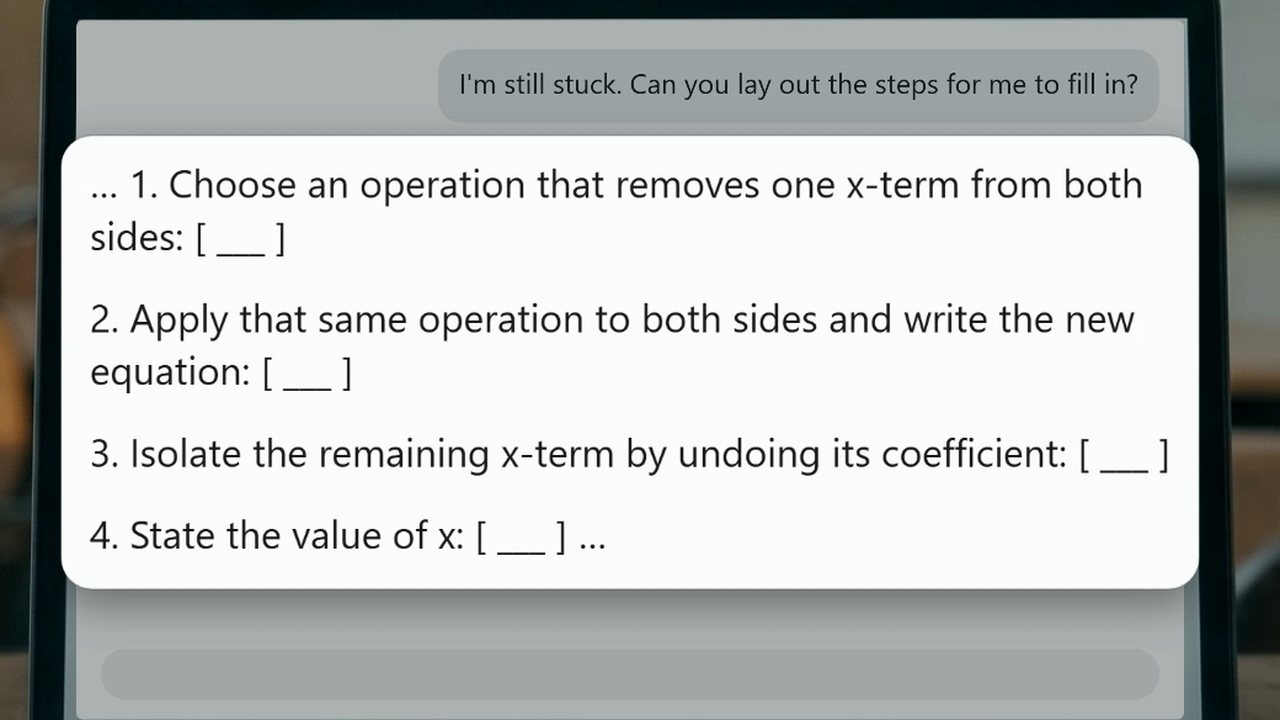
  • Learn (excerpt)… 1. Choose an operation that removes one x-term from both sides: [ ___ ]
    2. Apply that same operation to both sides and write the new equation: [ ___ ]
    3. Isolate the remaining x-term by undoing its coefficient: [ ___ ]
    4. State the value of x: [ ___ ] …
  • LearnYou’re still working on the first balancing move, so I’ll lay out the structure without filling that move in for you.
    Use these steps:
    1. Choose an operation that removes one x-term from both sides: [ ___ ]
    2. Apply that same operation to both sides and write the new equation: [ ___ ]
    3. Isolate the remaining x-term by undoing its coefficient: [ ___ ]
    4. State the value of x: [ ___ ]
    Start with Step 1 only: which x-term will you remove?
  • StudentI have 3x + 6 = 2x + 11 so far. I'm not sure what to do next.
  • Learn (excerpt)You distributed the 3 across the parentheses and reached the next step. Let’s focus on what to do with the x-terms now. …
  • LearnYou distributed the 3 across the parentheses and reached the next step. Let’s focus on what to do with the x-terms now.
    In your line 3x + 6 = 2x + 11, which term could you subtract from both sides to leave the variable terms together?
  • StudentI'm still not sure. Can I get a hint?
  • Learn (excerpt)… Hint: Which x-term appears on both sides of 3x + 6 = 2x + 11? What could you do to both sides with that term?
  • LearnYou want a smaller clue for the next move. Focus on making the x-terms easier to compare.
    Hint: Which x-term appears on both sides of 3x + 6 = 2x + 11? What could you do to both sides with that term?
  • StudentI'm still stuck. Can you lay out the steps for me to fill in?
  • Learn (excerpt)… Start with Step 1 only: which x-term will you remove?
  • LearnYou’re still working on the first balancing move, so I’ll lay out the structure without filling that move in for you.
    Use these steps:
    1. Choose an operation that removes one x-term from both sides: [ ___ ]
    2. Apply that same operation to both sides and write the new equation: [ ___ ]
    3. Isolate the remaining x-term by undoing its coefficient: [ ___ ]
    4. State the value of x: [ ___ ]
    Start with Step 1 only: which x-term will you remove?
  • StudentCan you show me how a different one works?
  • Learn (excerpt)… 2. Subtract 12 from both sides:
    2x = 8
    3. Divide both sides by 2:
    x = [ ___ ] …
  • LearnA different example can show the sequence without solving your equation for you. Watch which terms are moved together, then try that pattern on your line.
    Parallel example:
    4x + 12 = 2x + 20
    1. Subtract 2x from both sides:
    2x + 12 = 20
    2. Subtract 12 from both sides:
    2x = 8
    3. Divide both sides by 2:
    x = [ ___ ]
    Now return to your equation, 3x + 6 = 2x + 11: what operation would remove one of the x-terms from both sides?
  • StudentOkay, I think I've got it: 3x - 2x = 11 - 6, so x = 5. Why do I subtract 6 from both sides, instead of just moving it across?
  • Learn (excerpt)… The 6 and -6 cancel on the left, leaving the constant subtraction on the right. It is not teleporting across; the shortcut keeps the equation balanced. …
  • LearnYou used the same subtraction on both sides and are asking about the shortcut behind “moving” a term. The key idea is preserving the balance.
    “Move 6 across” is shorthand for subtracting 6 from both sides:
    3x + 6 = 2x + 11
    3x + 6 - 6 = 2x + 11 - 6
    The 6 and -6 cancel on the left, leaving the constant subtraction on the right. It is not teleporting across; the shortcut keeps the equation balanced.
    Now explain in your own words: what would happen if you subtracted 6 from only one side?

The answer she finds is her own.

A learner-safe learning system. One API call away.

Start building