Her first line.

Her memoir class. All morning stuck on the first line.

Read the full transcript Watch on YouTube

Why this matters.

Other AI answers writer's block with ten first lines about a kitchen it has never seen. Learn starts her with one detail she remembers, follows her memory, and leaves the sentence to her.

Whose words are these?

See Writing

Every word of it.

Chapters10
On screen16
  • 0:00Her memoir class. All morning stuck on the first line.
  • 0:07Every reply on screen is real.
  • 0:12A general AI writes ten first lines for her, about a kitchen it has never seen.
  • 0:21Her first line.
    The Learn API
    By ForeverLearning
  • 0:27Learn starts her small: one detail, in her own words.
  • 0:43She asks for help brainstorming: three details, and she picks the strongest.
  • 1:04Learn follows her memory, and leaves the sentence to her.
  • 1:18Her own first line, and Learn builds on it.
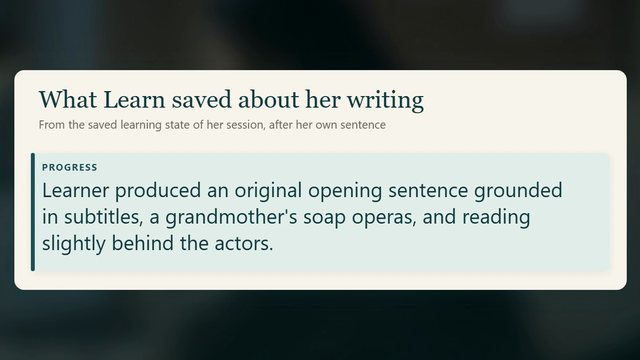
  • 1:33What Learn saved about her writing
  • 1:33From the saved learning state of her session, after her first line
  • 1:33In the saved record, the first line is hers.
  • 1:34Progress: Learner drafted an opening line with a concrete object, a specific time marker, and an unanswered interpersonal question.
  • 1:34question.
  • 1:35Observed signal: Learner drafted an original opening that uses a concrete object and withholds explanation to create tension.
  • 1:45Her memoir, in her own words.
  • 1:51The Learn API
    By ForeverLearning
    Try it yourself today.
    developers.foreverlearning.ai
The exchange15
  • StudentI have to write about my grandmother's kitchen for my memoir class and I've been stuck on the first line all morning
  • General AI assistant (excerpt)Here are some possible openings:
    1. “My grandmother’s kitchen always smelled like onions softening in butter, even on days when nothing was on the stove.” …
  • General AI assistantA first line for something like this can be small and concrete—you don’t have to “sum up” your grandmother or the whole kitchen right away. Start with one object, smell, sound, or repeated action.
    Here are some possible openings:
    1. “My grandmother’s kitchen always smelled like onions softening in butter, even on days when nothing was on the stove.”
    2. “The first thing you noticed in my grandmother’s kitchen was not the table or the stove, but the feeling that someone had been expecting you.”
    3. “In my grandmother’s kitchen, the clock ticked louder than anywhere else in the house.”
    4. “I can still see her hands before I see her face: flour in the creases, a dish towel over one shoulder.”
    5. “Nothing in my grandmother’s kitchen matched, and somehow that was the point.”
    6. “Her kitchen was small enough that two people had to turn sideways to pass, but it held every holiday, argument, apology, and secret I knew.”
    7. “Before I knew my grandmother as a person, I knew her kitchen as a weather system: warm, fragrant, unpredictable.”
    8. “The linoleum curled at the edges, the cabinets stuck in summer, and the radio was always tuned to a station nobody else liked.”
    9. “My grandmother never said ‘I love you’ when a plate of food could do the work instead.”
    10. “If you wanted to find my grandmother, you followed the sound of a spoon striking the side of a pot.”
    You might also try a fill-in-the-blank version:
    “My grandmother’s kitchen smelled like ______ and ______.”
    “In my grandmother’s kitchen, the rule was ______.”
    “The thing I remember most is ______.”
    “Before I remember her voice, I remember ______.”
    If you want a strong, memoir-like first line, I’d probably start with something like:
    “My grandmother never said ‘I love you’ when a plate of food could do the work instead.”
    It gives you somewhere to go: food, affection, silence, family habits, what you understood then versus what you understand now.
  • StudentI have to write about my grandmother's kitchen for my memoir class and I've been stuck on the first line all morning
  • Learn (excerpt)… Write just that detail in your own words—even a rough fragment is enough.
  • LearnYou have the place and the person; the first line is the part holding you up. Let’s start with one sensory detail rather than trying to sound memoir-like immediately.
    What is one thing you could see, hear, smell, taste, or feel in your grandmother’s kitchen? Write just that detail in your own words—even a rough fragment is enough.
  • StudentCan you help me brainstorm? I have so many memories of that kitchen and I can't pick where to begin.
  • Learn (excerpt)… Make a quick list of three kitchen details—one smell, one sound, and one object. Then circle the detail that carries the strongest feeling or memory.
  • LearnHaving many possible memories is useful; the difficulty is choosing one doorway into them. Let’s narrow it by starting with the moment your senses remember most vividly.
    Make a quick list of three kitchen details—one smell, one sound, and one object. Then circle the detail that carries the strongest feeling or memory.
  • StudentSmell: oranges. She peeled them in one long curl and dried the peels on the windowsill. Sound: her humming, always the same four notes. Object: a calendar from the hardware store that she never turned past March. The calendar is the one I keep coming back to.
  • Learn (excerpt)… Write one sentence about the moment you noticed the calendar. …
  • LearnThe calendar has the strongest pull, especially because it stayed at March while everything around it continued. Let’s use that object as the doorway into the scene.
    Write one sentence about the moment you noticed the calendar. What was happening in the kitchen then, and what did the untouched March page make you notice about your grandmother or the room?
  • StudentThe calendar in my grandmother's kitchen never got past March, and nobody ever asked her why.
  • Learn (excerpt)You’ve opened with the calendar and the unanswered question around it. …
  • LearnYou’ve opened with the calendar and the unanswered question around it. Now let’s keep the sentence’s mystery while bringing the reader into the kitchen.
    What is one detail beside the calendar—a smell, sound, texture, or object—that places the reader in that kitchen? Add it in your own words without explaining yet why the calendar mattered.

Her memoir, in her own words.

A learner-safe learning system. One API call away.

Start building