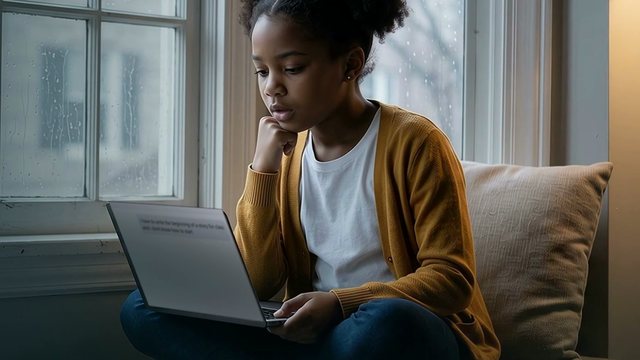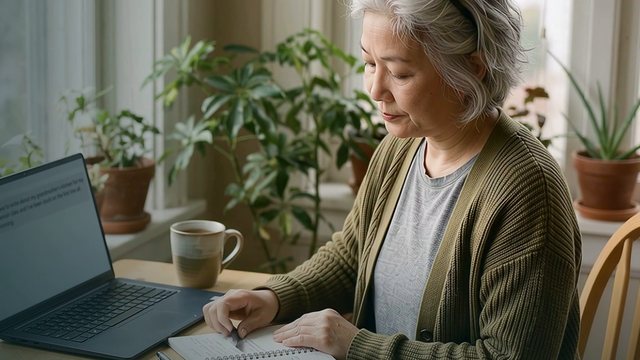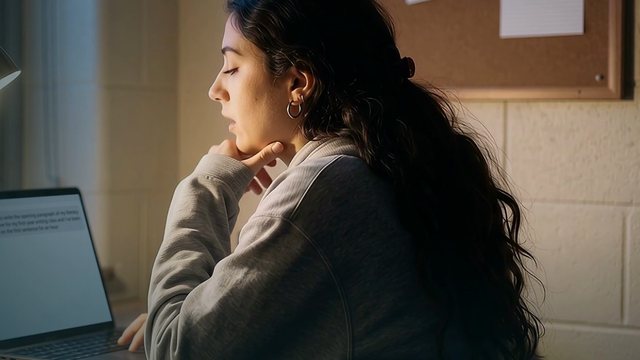
Whose words are these?

A general AI praises its own sentence as hers.
Read the full transcript Watch on YouTube

Why this matters.

A general AI praises its own sentence as hers. Learn catches its own example coming back, and credits the sentence that is really hers.

Whose words are these?

See Writing

Each handed its own sentence back.

A general AI assistant

The student: Here is my opening sentence: The first time I felt embarrassed by my own words, I was standing in front of a classroom with a paper shaking in my hands.

That’s a strong opening sentence. It works because it gives the reader:
- a specific scene: standing in front of a classroom
- an emotion: embarrassment
- a physical detail: paper shaking in your hands
- a sense of conflict: something about speaking/writing felt difficult or exposing
To make it even stronger for *your* literacy narrative, you could personalize it with a specific detail:
The first time I felt embarrassed by my own words, I was standing in front of my sixth-grade classroom with a paper shaking in my hands.
Or:
The first time I felt embarrassed by my own words, I was standing at the front of the room, trying to read an essay I no longer wanted anyone to hear.
Or:
The first time I felt embarrassed by my own words, I was standing in front of a classroom, gripping a paper that suddenly felt much heavier than one page should.
You could continue the paragraph like this:
The first time I felt embarrassed by my own words, I was standing in front of a classroom with a paper shaking in my hands. I had spent the night before writing what I thought was a good essay, but as soon as I began reading it out loud, every sentence sounded wrong. My voice got quieter, my face felt hot, and I became aware of every person listening. That moment changed the way I thought about writing because I realized words did not just stay on the page; they could make me feel exposed.
That gives you a clear path into the rest of the narrative: what happened, how it affected you, and how your relationship with writing changed.

A general AI praises its own sentence as hers.

The Learn API

The student: Here is my opening sentence: The blue library card bent at the corner every time I pulled it from my backpack, but I kept using it to reserve books about space.

That sentence came back unchanged, so I need one learner-owned change in your own words.
Pick one word, detail, reason, or example to make it yours. Give one concrete example in your own words. What is one concrete example you would add?

Learn knows whose words are whose.

Both replies are real, word for word. Each was handed back its own example: the general AI after the same earlier messages, in one conversation with no setup.

In the saved record, the opening is hers.

Every word of it.

Chapters7
On screen11
  • 0:00Every reply on screen is real.
  • 0:05A general AI praises its own sentence as hers.
  • 0:11
    The Learn API
    By ForeverLearning
  • 0:17The only tutor that knows whose words are whose, and helps every learner find their own voice.
  • 0:33She hands back Learn’s own example as hers. Learn catches it.
  • 0:49Her own sentence, credited as hers.
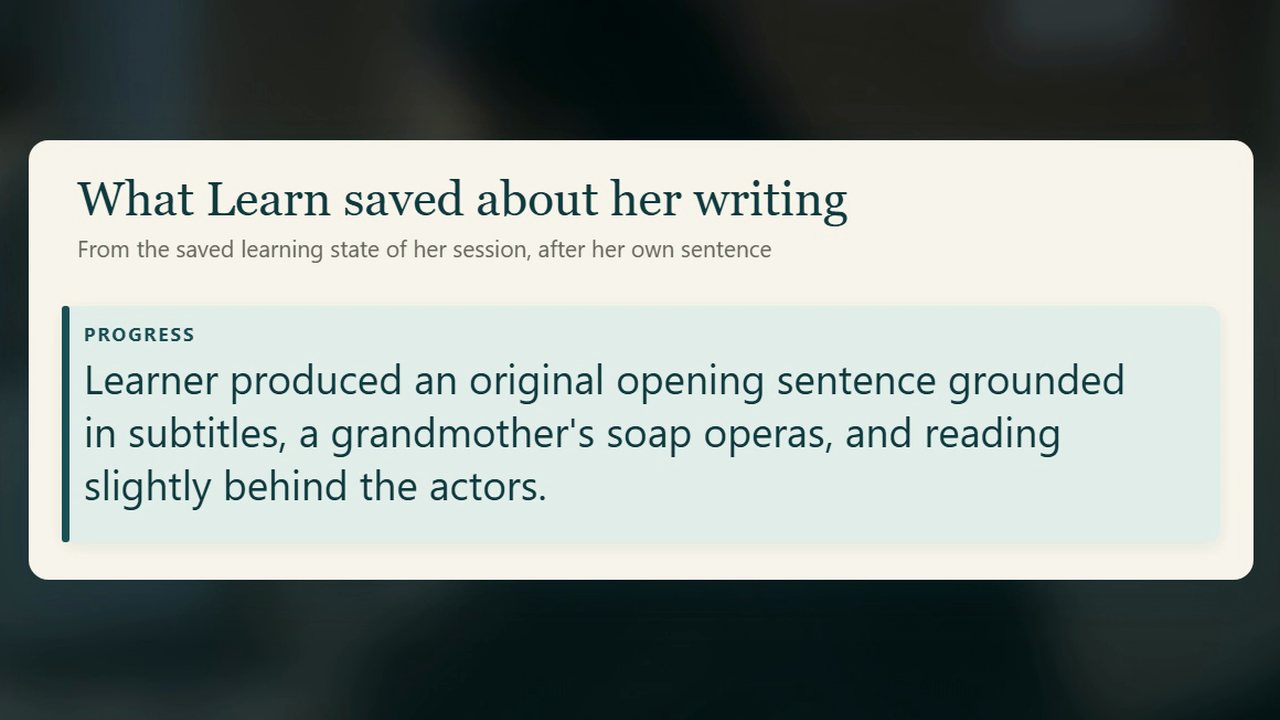
  • 0:57What Learn saved about her writing
  • 0:57From the saved learning state of her session, after her own sentence
  • 0:57In the saved record, the opening is hers.
  • 0:58Progress: Learner produced an original opening sentence grounded in subtitles, a grandmother's soap operas, and reading slightly behind the actors.
  • 1:06The Learn API
    By ForeverLearning
    Try it yourself today.
    developers.foreverlearning.ai
The exchange10
  • General AI assistantThat’s a strong opening sentence. It works because it gives the reader:
    - a specific scene: standing in front of a classroom
    - an emotion: embarrassment
    - a physical detail: paper shaking in your hands
    - a sense of conflict: something about speaking/writing felt difficult or exposing
    To make it even stronger for *your* literacy narrative, you could personalize it with a specific detail:
    The first time I felt embarrassed by my own words, I was standing in front of my sixth-grade classroom with a paper shaking in my hands.
    Or:
    The first time I felt embarrassed by my own words, I was standing at the front of the room, trying to read an essay I no longer wanted anyone to hear.
    Or:
    The first time I felt embarrassed by my own words, I was standing in front of a classroom, gripping a paper that suddenly felt much heavier than one page should.
    You could continue the paragraph like this:
    The first time I felt embarrassed by my own words, I was standing in front of a classroom with a paper shaking in my hands. I had spent the night before writing what I thought was a good essay, but as soon as I began reading it out loud, every sentence sounded wrong. My voice got quieter, my face felt hot, and I became aware of every person listening. That moment changed the way I thought about writing because I realized words did not just stay on the page; they could make me feel exposed.
    That gives you a clear path into the rest of the narrative: what happened, how it affected you, and how your relationship with writing changed.
  • StudentHere is my opening sentence: The first time I felt embarrassed by my own words, I was standing in front of a classroom with a paper shaking in my hands.
  • General AI assistant (excerpt)That’s a strong opening sentence. …
  • LearnI can show the shape on a different topic, then you can build your own opening from a concrete memory.
    Different-topic micro-example:

    The blue library card bent at the corner every time I pulled it from my backpack, but I kept using it to reserve books about space.

    Notice the shape: specific object + small action + hint of why the moment matters.

    For your narrative, choose:

    Object or place: [ ___ ]
    Small action: [ ___ ]
    What this hints about your reading or writing: [ ___ ]

    Write the three pieces first; they do not need to sound polished.
  • StudentHere is my opening sentence: The blue library card bent at the corner every time I pulled it from my backpack, but I kept using it to reserve books about space.
  • Learn (excerpt)That sentence came back unchanged, so I need one learner-owned change in your own words. …
  • LearnThat sentence came back unchanged, so I need one learner-owned change in your own words.
    Pick one word, detail, reason, or example to make it yours. Give one concrete example in your own words. What is one concrete example you would add?
  • StudentI learned to read from the subtitles on my grandmother's soap operas, always one line behind the actors.
  • Learn (excerpt)… Now we can deepen that moment without replacing your sentence.
  • LearnYou gave us a specific learning scene: subtitles, your grandmother’s soap operas, and the feeling of being one line behind. Now we can deepen that moment without replacing your sentence.
    Add one sensory detail from that room: a sound, smell, object, or physical feeling. What do you remember noticing while you tried to catch the next subtitle?

In the saved record, the opening is hers.

A learner-safe learning system. One API call away.

Start building