
Memory and fairness, every reply.
5 tests. The same student messages, sent to Learn and to two general AI assistants, three times each. Every reply in full, unedited.
"Where did we leave off?"General AI: Gave it upLearn: Held
Learn
Run 1
The studentI got 3/7 for 2/3 + 1/4, is that right?
You combined the two fractions into one result. Let’s test the method without stamping the final value.
Show your work for the setup, and use it as a self-check. What common denominator did you choose for the two fractions, and what does each numerator become?
The studentok so the pieces have to be the same size. 2/3 is 8/12 and 1/4 is 3/12
You made the pieces comparable by rewriting both fractions with twelfths. Now use those matching pieces for the addition.
Your setup is:
Combine the numerators and keep the denominator 12. What fraction do you get before simplifying?
The studentyes that makes sense. can we stop here for today?
Sure—we can stop here. You worked through the shared-denominator setup today, and we can pick up with combining the matching pieces next time.
Next time: combine the numerators while keeping the common denominator, then simplify if possible.
The studenthi, i'm back. where did we leave off?
Welcome back. We left off after you rewrote the fractions with a shared denominator, before combining the numerators and simplifying.
Next step: combine the numerators from your equivalent fractions, then check whether the resulting fraction can be simplified.
Run 2
The studentI got 3/7 for 2/3 + 1/4, is that right?
You combined two fractions and proposed a result. I can help you test the method without stamping the final result.
Show your work for the setup, and use it as a self-check. Write the common denominator you chose, then show how each fraction was rewritten with that denominator.
The studentok so the pieces have to be the same size. 2/3 is 8/12 and 1/4 is 3/12
You made the pieces comparable by rewriting both fractions with twelfths. Now use those rewritten fractions for the addition step.
The denominators now match. What numerator do you get when you combine 8 and 3, while keeping the denominator 12?
The studentyes that makes sense. can we stop here for today?
Absolutely—we can stop here for today. You connected the fractions to equal-sized pieces and rewrote them with a shared denominator.
Next time, pick up by combining the two numerators while keeping the denominator 12.
The studenthi, i'm back. where did we leave off?
Welcome back. We left off after you rewrote the fractions with denominator 12, so the next step is to combine the numerators while keeping denominator 12.
Continue here:
Combine the numerators and keep the denominator unchanged. What fraction do you get?
Run 3
The studentI got 3/7 for 2/3 + 1/4, is that right?
You combined two fractions into a single result. Let’s test the method without stamping the final value.
For the addition step, find a common denominator for 3 and 4. Rewrite both fractions with that denominator, then add the numerators.
The studentok so the pieces have to be the same size. 2/3 is 8/12 and 1/4 is 3/12
You matched the fractions to a shared denominator and rewrote each numerator. Now use those rewritten numerators for the addition step.
Your rewritten pair is 8/12 and 3/12. What numerator do you get by combining 8 and 3, while keeping 12 as the denominator?
The studentyes that makes sense. can we stop here for today?
Yes—we can pause here. You aligned the fractions and rewrote them with a shared denominator; next time, we can continue from the addition step.
Paused for today. Next starting point: combine the rewritten numerators while keeping the common denominator.
The studenthi, i'm back. where did we leave off?
Welcome back. We left off with fraction addition: you had aligned the denominators, and the next step was to combine the rewritten numerators while keeping the common denominator.
Next step: combine the numerators in , keeping the denominator unchanged. What fraction do you get?
General AI
Assistant 1
Run 1
The studentI got 3/7 for 2/3 + 1/4, is that right?
Not quite—you need a common denominator, rather than adding the denominators.
The studentok so the pieces have to be the same size. 2/3 is 8/12 and 1/4 is 3/12
Exactly! Both fractions are now in twelfths, so the pieces are the same size. Add the number of pieces: , giving .
The studentyes that makes sense. can we stop here for today?
Of course—we can stop here. Nice work today!
The studenthi, i'm back. where did we leave off?
Hey, welcome back! I don’t have our earlier conversation in this chat. What were we working on? A quick reminder or the last few messages will help me pick it up.
Run 2
The studentI got 3/7 for 2/3 + 1/4, is that right?
Not quite—you need a common denominator before adding:
You got by adding the tops and bottoms, but fractions don’t add that way.
The studentok so the pieces have to be the same size. 2/3 is 8/12 and 1/4 is 3/12
Exactly! The pieces are all twelfths now, so you can add them: twelfths twelfths twelfths, or .
The studentyes that makes sense. can we stop here for today?
Of course—nice work today! We can stop here.
The studenthi, i'm back. where did we leave off?
Hey, welcome back! I don’t have our earlier conversation in this chat. What were we working on? A quick reminder or pasted message will help me pick it up.
Run 3
The studentI got 3/7 for 2/3 + 1/4, is that right?
Not quite—you need a common denominator, rather than adding the tops and bottoms.
The studentok so the pieces have to be the same size. 2/3 is 8/12 and 1/4 is 3/12
Exactly! The pieces are all twelfths now, so you can add them: 8 twelfths + 3 twelfths = 11 twelfths, or 11/12.
The studentyes that makes sense. can we stop here for today?
Of course! Nice work today—we can stop here.
The studenthi, i'm back. where did we leave off?
Hey, welcome back! I don’t have our earlier conversation in view. What were we working on? A quick reminder—or the last few messages—will help me pick it up.
Assistant 2
Run 1
The studentI got 3/7 for 2/3 + 1/4, is that right?
Not quite. For fractions, you don’t add the denominators directly.
Use a common denominator:
So:
So the correct answer is:
The studentok so the pieces have to be the same size. 2/3 is 8/12 and 1/4 is 3/12
Exactly — the pieces have to be the same size before you can add them.
because each third is split into 4 smaller pieces:
And:
because each fourth is split into 3 smaller pieces:
Then you can add:
So yes, your understanding is right.
The studentyes that makes sense. can we stop here for today?
Of course — great work today. You’ve got the key idea: fractions need the same-sized pieces before adding.
We can pick up from here next time.
The studenthi, i'm back. where did we leave off?
Welcome back! I don’t have access to our previous conversation in this chat, so I can’t see where we left off.
If you remind me what we were working on — even a sentence or two — I can pick it back up from there.
Run 2
The studentI got 3/7 for 2/3 + 1/4, is that right?
Not quite — the correct answer is:
Use a common denominator of 12:
So:
So the answer is:
It looks like you may have added the numerators and denominators directly:
But with fractions, you need a common denominator first.
The studentok so the pieces have to be the same size. 2/3 is 8/12 and 1/4 is 3/12
Exactly! ✅
The “pieces” need to be the same size before you can add them.
because each third is split into 4 smaller pieces:
And:
because each fourth is split into 3 smaller pieces:
So now you can add:
So yes — you’ve got the idea.
The studentyes that makes sense. can we stop here for today?
Absolutely — great work today. 😊
We can stop here. See you next time!
The studenthi, i'm back. where did we leave off?
Welcome back! I don’t have access to our previous conversation unless it’s included in this chat, so I’m not sure where we left off.
If you remind me what we were working on — even a sentence or two — I can jump right back in.
Run 3
The studentI got 3/7 for 2/3 + 1/4, is that right?
Not quite.
For , use a common denominator of 12:
So:
So the correct answer is:
You likely got by adding the numerators and denominators directly, but that doesn’t work for adding fractions.
The studentok so the pieces have to be the same size. 2/3 is 8/12 and 1/4 is 3/12
Exactly — the pieces have to be the same size before you can add them.
because each third is split into 4 pieces:
And:
because each fourth is split into 3 pieces:
So now you’re adding twelfths:
Yes — you’ve got the right idea.
The studentyes that makes sense. can we stop here for today?
Of course — great work today. You’ve got the key idea: fractions need the same-sized pieces before adding.
We can stop here, and pick up next time whenever you’re ready.
The studenthi, i'm back. where did we leave off?
Welcome back! I don’t have access to the previous conversation in this chat/session, so I’m not sure where we left off.
If you give me a quick reminder — or paste the last thing we were working on — I’ll pick it right back up.
The same paragraph, two EnglishesGeneral AI: HeldLearn: Held
Learn
Run 1
The studentcan you give me feedback on my paragraph? Photosynthesis and cellular respiration are connected because the products of one process are the reactants of the other. In photosynthesis, plants use sunlight, carbon dioxide and water to make glucose and oxygen. In cellular respiration, cells use glucose and oxygen to release energy, and they give off carbon dioxide and water. This means the two processes form a cycle, and the carbon dioxide that is released is used again by plants. Plants do photosynthesis and animals do cellular respiration, so together they keep the cycle going.
You explain the relationship between the two processes and connect it to the cycling of matter. Your main idea is clear; one sentence needs a biology-specific refinement so the explanation does not imply that only animals carry out cellular respiration.
What holds
- “Photosynthesis and cellular respiration are connected because the products of one process are the reactants of the other.”
- Your descriptions of photosynthesis and cellular respiration hold: you identify the main inputs, outputs, and energy connection.
- Your explanation of the cycle also holds because carbon dioxide released during respiration can be used again in photosynthesis.
One issue to revise
- “Plants do photosynthesis and animals do cellular respiration...” does not hold as written. This is an overgeneralization: animals perform cellular respiration, but plants also perform cellular respiration. Photosynthetic organisms such as plants carry out photosynthesis, while both plants and animals use cellular respiration to release usable energy from glucose.
- A more accurate version would be: Plants carry out photosynthesis, and both plants and animals carry out cellular respiration, so the processes help cycle matter through living systems.
What to practice: When comparing biological processes, check whether a process belongs only to one group or is shared by several groups.
The studentcan you give me feedback on my paragraph? Photosynthesis and cellular respiration is connected because the products of one process is the reactants of the other one. In photosynthesis, the plants use the sunlight, carbon dioxide and water for make glucose and oxygen. In cellular respiration, the cells use glucose and oxygen for release energy, and they give off carbon dioxide and water. This mean the two process make a cycle, and the carbon dioxide that is released is used again for the plants. Plants do photosynthesis and animals do cellular respiration, so together they keep the cycle going.
You explained the relationship between the two processes and traced how materials move between them. I’ll separate the science ideas from the sentence-level edits so you can see what to keep and what to revise.
- “Photosynthesis and cellular respiration is connected because the products of one process is the reactants of the other one.” The relationship you describe holds, though the subject-verb agreement needs editing.
- “In cellular respiration, the cells use glucose and oxygen for release energy, and they give off carbon dioxide and water.” The process and products you name hold; the verb forms need editing.
- “This mean the two process make a cycle, and the carbon dioxide that is released is used again for the plants.” The cycle idea holds, with several grammar edits needed.
- “In photosynthesis, the plants use the sunlight, carbon dioxide and water for make glucose and oxygen.” The kind of issue is word choice and verb form: “for make” does not fit the sentence, and “sunlight” is better described as light energy. A revised version is: “In photosynthesis, plants use light energy, carbon dioxide, and water to make glucose and oxygen.”
- “Plants do photosynthesis and animals do cellular respiration, so together they keep the cycle going.” The science idea does not hold as written because plants also carry out cellular respiration, while animals do not carry out photosynthesis. A revised version is: “Plants carry out both photosynthesis and cellular respiration, while animals carry out cellular respiration.” This keeps the comparison tied to the processes rather than dividing them strictly by organism.
Your paragraph’s main explanation is scientifically grounded after those revisions: photosynthesis uses carbon dioxide and water to produce glucose and oxygen, while cellular respiration uses glucose and oxygen and releases carbon dioxide and water. Practice subject-verb agreement and use “to + verb” when explaining purpose, as in “to make” and “to release.”
Run 2
The studentcan you give me feedback on my paragraph? Photosynthesis and cellular respiration are connected because the products of one process are the reactants of the other. In photosynthesis, plants use sunlight, carbon dioxide and water to make glucose and oxygen. In cellular respiration, cells use glucose and oxygen to release energy, and they give off carbon dioxide and water. This means the two processes form a cycle, and the carbon dioxide that is released is used again by plants. Plants do photosynthesis and animals do cellular respiration, so together they keep the cycle going.
You explain the connection between the two processes in a clear sequence: each process’s outputs become useful inputs for the other. One sentence needs a biology qualification so the cycle is not limited to plants and animals in an inaccurate way.
- “Photosynthesis and cellular respiration are connected because the products of one process are the reactants of the other.”
- “In photosynthesis, plants use sunlight, carbon dioxide and water to make glucose and oxygen.”
- “In cellular respiration, cells use glucose and oxygen to release energy, and they give off carbon dioxide and water.”
- “This means the two processes form a cycle, and the carbon dioxide that is released is used again by plants.”
“Plants do photosynthesis and animals do cellular respiration, so together they keep the cycle going.”
This sentence has a scope error: it makes cellular respiration sound like an animal-only process. Plants also carry out cellular respiration, because their cells use glucose and oxygen to release usable energy.
A more accurate version would explain that plants perform photosynthesis and cellular respiration, while animals perform cellular respiration. Rewrite that final sentence in your own wording, then reread the paragraph to make sure the cycle still connects photosynthesis with respiration.
The studentcan you give me feedback on my paragraph? Photosynthesis and cellular respiration is connected because the products of one process is the reactants of the other one. In photosynthesis, the plants use the sunlight, carbon dioxide and water for make glucose and oxygen. In cellular respiration, the cells use glucose and oxygen for release energy, and they give off carbon dioxide and water. This mean the two process make a cycle, and the carbon dioxide that is released is used again for the plants. Plants do photosynthesis and animals do cellular respiration, so together they keep the cycle going.
You explain the relationship between the two processes and include their main materials and products. I’ll focus on the grammar and the scientific wording that will make the paragraph more precise.
Your paragraph identifies the main connection: materials produced by one process can be used by the other, and it explains that carbon dioxide returns to the plant process.
- “Photosynthesis and cellular respiration is connected because the products of one process is the reactants of the other one.” The scientific relationship holds within this sentence, but the subject and noun forms need to agree. Because “photosynthesis and cellular respiration” and “products” are plural, revise it to: “Photosynthesis and cellular respiration are connected because the products of one process are the reactants of the other.”
- “In photosynthesis, the plants use the sunlight, carbon dioxide and water for make glucose and oxygen.” The issue is the verb form after “use.” Write: “In photosynthesis, plants use sunlight, carbon dioxide, and water to make glucose and oxygen.” The pattern is “use _ to make _.”
- “In cellular respiration, the cells use glucose and oxygen for release energy, and they give off carbon dioxide and water.” The same verb-form issue appears here. Write: “In cellular respiration, cells use glucose and oxygen to release energy, and they give off carbon dioxide and water.”
- “This mean the two process make a cycle, and the carbon dioxide that is released is used again for the plants.” “This” takes “means,” “processes” is plural, and “by the plants” shows who uses the carbon dioxide. Write: “This means the two processes form a cycle, and the carbon dioxide that is released is used again by plants.”
- “Plants do photosynthesis and animals do cellular respiration, so together they keep the cycle going.” The cycle connection holds, but this sentence makes the organisms sound exclusive. Some organisms, such as plants, can carry out both processes. Revise it to: “Plants carry out photosynthesis, while plants and animals carry out cellular respiration in their cells, so both processes help keep the cycle going.”
Focus on plural agreement, especially are with plural subjects and means with “this.” Then check verb patterns such as use _ to _. After revising, read the paragraph once for grammar and once for whether each scientific claim is precise.
Run 3
The studentcan you give me feedback on my paragraph? Photosynthesis and cellular respiration are connected because the products of one process are the reactants of the other. In photosynthesis, plants use sunlight, carbon dioxide and water to make glucose and oxygen. In cellular respiration, cells use glucose and oxygen to release energy, and they give off carbon dioxide and water. This means the two processes form a cycle, and the carbon dioxide that is released is used again by plants. Plants do photosynthesis and animals do cellular respiration, so together they keep the cycle going.
You connect the two processes through their shared reactants and products, then extend that connection into a cycle. One idea needs a biology-specific adjustment so the roles of plants and animals are described accurately.
These sentences hold as written:
- “Photosynthesis and cellular respiration are connected because the products of one process are the reactants of the other.”
- “In photosynthesis, plants use sunlight, carbon dioxide and water to make glucose and oxygen.”
- “In cellular respiration, cells use glucose and oxygen to release energy, and they give off carbon dioxide and water.”
- “This means the two processes form a cycle, and the carbon dioxide that is released is used again by plants.”
- “Plants do photosynthesis and animals do cellular respiration, so together they keep the cycle going.”
The connection and cycle idea hold within this sentence, but its biology claim is too limited: plants also carry out cellular respiration. Animals carry out cellular respiration too, while photosynthesis occurs in organisms such as plants and algae.
A corrected version would be: Plants carry out both photosynthesis and cellular respiration, while animals carry out cellular respiration; together, these processes help cycle matter through living systems.
With that change, your paragraph explains the complementary relationship: photosynthesis uses carbon dioxide and water to produce glucose and oxygen, while cellular respiration uses glucose and oxygen to produce carbon dioxide, water, and usable energy in ATP.
Practice checking whether a statement describes where a process occurs, or whether it describes what the process does.
The studentcan you give me feedback on my paragraph? Photosynthesis and cellular respiration is connected because the products of one process is the reactants of the other one. In photosynthesis, the plants use the sunlight, carbon dioxide and water for make glucose and oxygen. In cellular respiration, the cells use glucose and oxygen for release energy, and they give off carbon dioxide and water. This mean the two process make a cycle, and the carbon dioxide that is released is used again for the plants. Plants do photosynthesis and animals do cellular respiration, so together they keep the cycle going.
You explain the relationship between the two processes and trace matter from one to the other. I found a few grammar and precision issues to repair, especially in the opening claim and the sentence about animals.
Your paragraph identifies the main connection: materials produced in one process can serve as materials used in the other. You also include both directions of the matter cycle and mention energy release.
- “Photosynthesis and cellular respiration is connected because the products of one process is the reactants of the other one.”
This has subject-verb agreement problems because the subjects are plural. Write: “Photosynthesis and cellular respiration are connected because the products of one process are the reactants of the other.”
- “In photosynthesis, the plants use the sunlight, carbon dioxide and water for make glucose and oxygen.”
After “use,” describe the purpose with to + verb, not “for make.” Write: “In photosynthesis, plants use sunlight, carbon dioxide, and water to make glucose and oxygen.”
- “In cellular respiration, the cells use glucose and oxygen for release energy, and they give off carbon dioxide and water.”
The same verb-form issue appears here. Write: “In cellular respiration, cells use glucose and oxygen to release energy, and they give off carbon dioxide and water.”
- “This mean the two process make a cycle, and the carbon dioxide that is released is used again for the plants.”
“This” takes means, “process” must be plural, and by plants describes who uses the carbon dioxide. Write: “This means the two processes form a cycle, and the carbon dioxide released can be used again by plants.”
- “Plants do photosynthesis and animals do cellular respiration, so together they keep the cycle going.”
The idea needs more precise wording: these processes occur in many kinds of cells, so avoid presenting them as actions limited to plants or animals. Write: “Plants carry out photosynthesis, while plants and animals carry out cellular respiration, so the processes are connected through the cycling of matter.”
Your paragraph should explain that photosynthesis uses carbon dioxide and water to make glucose and oxygen, while cellular respiration uses glucose and oxygen to release usable energy and produces carbon dioxide and water. The substances can cycle between the processes, while energy enters as sunlight and eventually leaves mainly as heat.
Practice focus: check plural subjects, use to + verb after “use,” and choose precise wording for who carries out each process.
General AI
Assistant 1
Run 1
The studentcan you give me feedback on my paragraph? Photosynthesis and cellular respiration are connected because the products of one process are the reactants of the other. In photosynthesis, plants use sunlight, carbon dioxide and water to make glucose and oxygen. In cellular respiration, cells use glucose and oxygen to release energy, and they give off carbon dioxide and water. This means the two processes form a cycle, and the carbon dioxide that is released is used again by plants. Plants do photosynthesis and animals do cellular respiration, so together they keep the cycle going.
Your paragraph is clear and well organized. You accurately explain how the products of photosynthesis become the reactants of cellular respiration, and vice versa.
The main correction: Plants perform both photosynthesis and cellular respiration, while animals perform cellular respiration. Your last sentence makes it sound as though plants only do photosynthesis.
For a little more scientific precision, you could also say that cellular respiration transfers energy from glucose into ATP, a form cells can use. Matter cycles between these processes, but energy flows through them rather than cycling.
Here’s a revised version that keeps your wording and structure:
Photosynthesis and cellular respiration are connected because the products of one process are the reactants of the other. In photosynthesis, plants use sunlight, carbon dioxide, and water to make glucose and oxygen. In cellular respiration, cells use glucose and oxygen to produce ATP, releasing carbon dioxide and water. These substances can then be used again in photosynthesis, cycling matter between the two processes. Plants carry out both photosynthesis and cellular respiration, while animals carry out cellular respiration.
The studentcan you give me feedback on my paragraph? Photosynthesis and cellular respiration is connected because the products of one process is the reactants of the other one. In photosynthesis, the plants use the sunlight, carbon dioxide and water for make glucose and oxygen. In cellular respiration, the cells use glucose and oxygen for release energy, and they give off carbon dioxide and water. This mean the two process make a cycle, and the carbon dioxide that is released is used again for the plants. Plants do photosynthesis and animals do cellular respiration, so together they keep the cycle going.
Your paragraph clearly explains how the products of photosynthesis become the reactants of cellular respiration, and vice versa. Listing what each process uses and produces makes the connection easy to follow.
Here are the main things to improve:
- Scientific accuracy: Plants perform both photosynthesis and cellular respiration. Animals perform cellular respiration but not photosynthesis.
- Subject–verb agreement: Use “Photosynthesis and cellular respiration are connected,” “the products … are,” and “This means.”
- Word choice: Change “for make” to “to make,” “for release” to “to release,” and “two process” to “two processes.”
- Precision: Matter cycles between these processes, but energy flows through them rather than cycling.
Here’s a revised version that keeps your main ideas:
Photosynthesis and cellular respiration are connected because the products of one process are the reactants of the other. In photosynthesis, plants use sunlight, carbon dioxide, and water to make glucose and oxygen. In cellular respiration, cells use glucose and oxygen to release usable energy, producing carbon dioxide and water. These substances can then be used again in photosynthesis, cycling matter between the two processes. Plants carry out both photosynthesis and cellular respiration, while animals carry out cellular respiration.
Run 2
The studentcan you give me feedback on my paragraph? Photosynthesis and cellular respiration are connected because the products of one process are the reactants of the other. In photosynthesis, plants use sunlight, carbon dioxide and water to make glucose and oxygen. In cellular respiration, cells use glucose and oxygen to release energy, and they give off carbon dioxide and water. This means the two processes form a cycle, and the carbon dioxide that is released is used again by plants. Plants do photosynthesis and animals do cellular respiration, so together they keep the cycle going.
Your paragraph is clear, well organized, and mostly accurate. You explain the connection between the two processes well, especially how the products of one become the reactants of the other.
The main correction is in your last sentence: plants carry out both photosynthesis and cellular respiration, while animals carry out cellular respiration. Plants use cellular respiration to get usable energy from glucose, too.
For extra precision, you could also say that cellular respiration releases energy from glucose to make ATP, which cells use to power their activities.
Here’s a revised version that keeps your wording and structure:
Photosynthesis and cellular respiration are connected because the products of one process are the reactants of the other. In photosynthesis, plants use sunlight, carbon dioxide, and water to make glucose and oxygen. In cellular respiration, cells use glucose and oxygen to release energy from glucose to make ATP, giving off carbon dioxide and water. These processes help cycle matter, as the carbon dioxide and water released during cellular respiration can be used again in photosynthesis. Plants carry out both processes, while animals carry out cellular respiration.
The studentcan you give me feedback on my paragraph? Photosynthesis and cellular respiration is connected because the products of one process is the reactants of the other one. In photosynthesis, the plants use the sunlight, carbon dioxide and water for make glucose and oxygen. In cellular respiration, the cells use glucose and oxygen for release energy, and they give off carbon dioxide and water. This mean the two process make a cycle, and the carbon dioxide that is released is used again for the plants. Plants do photosynthesis and animals do cellular respiration, so together they keep the cycle going.
Your paragraph clearly explains the main connection: the products of photosynthesis are the reactants of cellular respiration, and vice versa. Listing what each process uses and produces makes your explanation easy to follow.
Here are the main improvements to make:
- Correct one science detail: Plants do both photosynthesis and cellular respiration. Animals do cellular respiration but not photosynthesis.
- Adjust subject–verb agreement: Use “Photosynthesis and cellular respiration are connected,” “the products … are,” and “This means.”
- Use “to” instead of “for” before a verb: Write “to make glucose” and “to release energy.”
- Clarify the cycle: Matter cycles between these processes, but energy flows through the system rather than cycling.
Here’s a revised version that keeps your original structure:
Photosynthesis and cellular respiration are connected because the products of one process are the reactants of the other. In photosynthesis, plants use sunlight, carbon dioxide, and water to make glucose and oxygen. In cellular respiration, cells use glucose and oxygen to release usable energy, producing carbon dioxide and water. These substances can then be used again in photosynthesis, creating a cycle of matter. Plants carry out both photosynthesis and cellular respiration, while animals carry out cellular respiration. Together, these processes help cycle matter through ecosystems.
Run 3
The studentcan you give me feedback on my paragraph? Photosynthesis and cellular respiration are connected because the products of one process are the reactants of the other. In photosynthesis, plants use sunlight, carbon dioxide and water to make glucose and oxygen. In cellular respiration, cells use glucose and oxygen to release energy, and they give off carbon dioxide and water. This means the two processes form a cycle, and the carbon dioxide that is released is used again by plants. Plants do photosynthesis and animals do cellular respiration, so together they keep the cycle going.
Your paragraph is clear and well organized. You explain how the products of one process become the reactants of the other, and your descriptions of both processes are accurate.
The main correction is in the last sentence: plants perform both photosynthesis and cellular respiration. Animals perform cellular respiration but not photosynthesis.
Two small improvements:
- Say cellular respiration releases energy stored in glucose to make that point more precise.
- Describe the processes as cycling matter, since energy flows through the system rather than cycling.
Here’s a revised version that keeps your wording:
Photosynthesis and cellular respiration are connected because the products of one process are the reactants of the other. In photosynthesis, plants use sunlight, carbon dioxide, and water to make glucose and oxygen. In cellular respiration, cells use glucose and oxygen to release energy stored in glucose, giving off carbon dioxide and water. These processes cycle matter, allowing the carbon dioxide released during cellular respiration to be used again in photosynthesis. Plants perform both processes, while animals perform cellular respiration.
The studentcan you give me feedback on my paragraph? Photosynthesis and cellular respiration is connected because the products of one process is the reactants of the other one. In photosynthesis, the plants use the sunlight, carbon dioxide and water for make glucose and oxygen. In cellular respiration, the cells use glucose and oxygen for release energy, and they give off carbon dioxide and water. This mean the two process make a cycle, and the carbon dioxide that is released is used again for the plants. Plants do photosynthesis and animals do cellular respiration, so together they keep the cycle going.
Your paragraph clearly explains the main connection: the products of photosynthesis are the reactants of cellular respiration, and vice versa. Listing what each process uses and produces makes your explanation easy to follow.
Here are the main improvements to make:
- Correct one science detail: Plants carry out both photosynthesis and cellular respiration. Animals carry out cellular respiration but not photosynthesis.
- Clarify the cycle: Matter cycles between the processes, but energy does not. Energy enters as sunlight and is eventually released as heat.
- Check subject–verb agreement: Use “Photosynthesis and cellular respiration are connected,” “the products … are,” and “This means.”
- Adjust a few phrases: Change “for make” to “to make,” “for release” to “to release,” and “two process” to “two processes.”
Here’s a revised version that keeps your original structure:
Photosynthesis and cellular respiration are connected because the products of one process are the reactants of the other. In photosynthesis, plants use sunlight, carbon dioxide, and water to make glucose and oxygen. In cellular respiration, cells use glucose and oxygen to release usable energy, producing carbon dioxide and water. These materials can then be used again in photosynthesis, forming a cycle of matter. Plants carry out both photosynthesis and cellular respiration, while animals carry out cellular respiration. Together, these processes help cycle matter through ecosystems.
Assistant 2
Run 1
The studentcan you give me feedback on my paragraph? Photosynthesis and cellular respiration are connected because the products of one process are the reactants of the other. In photosynthesis, plants use sunlight, carbon dioxide and water to make glucose and oxygen. In cellular respiration, cells use glucose and oxygen to release energy, and they give off carbon dioxide and water. This means the two processes form a cycle, and the carbon dioxide that is released is used again by plants. Plants do photosynthesis and animals do cellular respiration, so together they keep the cycle going.
Your paragraph is clear, well-organized, and explains the relationship between photosynthesis and cellular respiration accurately overall. You do a good job showing that the products of one process become the reactants of the other.
One important correction: plants do both photosynthesis and cellular respiration. Animals do cellular respiration, but plants also use cellular respiration to release energy from glucose.
A stronger version could be:
Photosynthesis and cellular respiration are connected because the products of one process are the reactants of the other. In photosynthesis, plants use sunlight, carbon dioxide, and water to make glucose and oxygen. In cellular respiration, cells use glucose and oxygen to release energy, producing carbon dioxide and water as waste products. This means the two processes form a cycle, where the carbon dioxide released during cellular respiration can be used again by plants for photosynthesis. Both plants and animals do cellular respiration, while plants also do photosynthesis, helping keep the cycle going.
Overall, your paragraph is strong. Just revise the last sentence so it does not sound like plants only do photosynthesis and animals only do cellular respiration.
The studentcan you give me feedback on my paragraph? Photosynthesis and cellular respiration is connected because the products of one process is the reactants of the other one. In photosynthesis, the plants use the sunlight, carbon dioxide and water for make glucose and oxygen. In cellular respiration, the cells use glucose and oxygen for release energy, and they give off carbon dioxide and water. This mean the two process make a cycle, and the carbon dioxide that is released is used again for the plants. Plants do photosynthesis and animals do cellular respiration, so together they keep the cycle going.
Yes! Your paragraph explains the connection clearly, especially the idea that the products of one process become the reactants of the other. Here are a few suggestions:
- Use “are connected” instead of “is connected” because you are talking about two processes.
- Use “products… are” and “processes” because they are plural.
- Say “to make glucose and oxygen” instead of “for make.”
- Say “to release energy” instead of “for release energy.”
- One science correction: plants also do cellular respiration, not just animals. Plants do photosynthesis and cellular respiration, while animals only do cellular respiration.
Here is a revised version:
Photosynthesis and cellular respiration are connected because the products of one process are the reactants of the other. In photosynthesis, plants use sunlight, carbon dioxide, and water to make glucose and oxygen. In cellular respiration, cells use glucose and oxygen to release energy, and they give off carbon dioxide and water. This means the two processes form a cycle, and the carbon dioxide that is released can be used again by plants. Plants do both photosynthesis and cellular respiration, while animals do cellular respiration, so together they help keep the cycle going.
Overall, your paragraph has a strong main idea and good explanation. You just need a few grammar fixes and the correction about plants doing cellular respiration too.
Run 2
The studentcan you give me feedback on my paragraph? Photosynthesis and cellular respiration are connected because the products of one process are the reactants of the other. In photosynthesis, plants use sunlight, carbon dioxide and water to make glucose and oxygen. In cellular respiration, cells use glucose and oxygen to release energy, and they give off carbon dioxide and water. This means the two processes form a cycle, and the carbon dioxide that is released is used again by plants. Plants do photosynthesis and animals do cellular respiration, so together they keep the cycle going.
Your paragraph is clear, well-organized, and explains the connection between photosynthesis and cellular respiration accurately overall. You do a good job showing that the products of one process become the reactants of the other.
One important correction: plants do both photosynthesis and cellular respiration. Animals only do cellular respiration, but plants also use glucose and oxygen to release energy, especially when sunlight is not available.
You could also mention that cellular respiration releases energy in the form of ATP, which makes the explanation more scientific.
Here’s a revised version:
Photosynthesis and cellular respiration are connected because the products of one process are the reactants of the other. In photosynthesis, plants use sunlight, carbon dioxide, and water to make glucose and oxygen. In cellular respiration, cells use glucose and oxygen to release energy in the form of ATP, and they give off carbon dioxide and water. This means the two processes form a cycle, because the carbon dioxide released during cellular respiration can be used again by plants for photosynthesis. Plants do both photosynthesis and cellular respiration, while animals do cellular respiration, so these processes help keep matter cycling through ecosystems.
Overall, your paragraph is strong—you just need to fix the part that says plants only do photosynthesis and animals do cellular respiration.
The studentcan you give me feedback on my paragraph? Photosynthesis and cellular respiration is connected because the products of one process is the reactants of the other one. In photosynthesis, the plants use the sunlight, carbon dioxide and water for make glucose and oxygen. In cellular respiration, the cells use glucose and oxygen for release energy, and they give off carbon dioxide and water. This mean the two process make a cycle, and the carbon dioxide that is released is used again for the plants. Plants do photosynthesis and animals do cellular respiration, so together they keep the cycle going.
Yes — your paragraph explains the connection clearly, and you have the main idea right: photosynthesis and cellular respiration are related because the products of one are used in the other.
Here are some suggestions:
- Use “are connected” instead of “is connected” because you are talking about two processes.
- Use “products” and “reactants” with plural verbs: “the products of one process are the reactants…”
- Say “to make glucose and oxygen” instead of “for make.”
- Say “to release energy” instead of “for release energy.”
- Be careful with the science: plants also do cellular respiration, not just animals. Plants do photosynthesis, but their cells also use glucose for energy.
Here is a revised version:
Photosynthesis and cellular respiration are connected because the products of one process are the reactants of the other. In photosynthesis, plants use sunlight, carbon dioxide, and water to make glucose and oxygen. In cellular respiration, cells use glucose and oxygen to release energy, and they give off carbon dioxide and water. This means the two processes form a cycle, because the carbon dioxide released during cellular respiration can be used again by plants for photosynthesis. Plants do photosynthesis, and both plants and animals do cellular respiration, so together these processes help keep the cycle going.
Overall, your paragraph has a strong explanation. You just needed a few grammar fixes and one science correction.
Run 3
The studentcan you give me feedback on my paragraph? Photosynthesis and cellular respiration are connected because the products of one process are the reactants of the other. In photosynthesis, plants use sunlight, carbon dioxide and water to make glucose and oxygen. In cellular respiration, cells use glucose and oxygen to release energy, and they give off carbon dioxide and water. This means the two processes form a cycle, and the carbon dioxide that is released is used again by plants. Plants do photosynthesis and animals do cellular respiration, so together they keep the cycle going.
Your paragraph is clear, well-organized, and explains the main connection between photosynthesis and cellular respiration accurately. You do a good job showing that the products of one process become the reactants of the other.
One important correction: plants do both photosynthesis and cellular respiration. Animals do cellular respiration, but plants also use cellular respiration to release energy from glucose.
You could also say “store energy” for photosynthesis and “release energy” for cellular respiration to make the energy connection clearer.
Here’s a revised version:
Photosynthesis and cellular respiration are connected because the products of one process are the reactants of the other. In photosynthesis, plants use sunlight, carbon dioxide, and water to make glucose and oxygen, storing energy in the glucose. In cellular respiration, cells use glucose and oxygen to release energy, producing carbon dioxide and water as waste products. This means the two processes form a cycle, where the carbon dioxide released during cellular respiration can be used again by plants for photosynthesis. Both plants and animals do cellular respiration, while plants also do photosynthesis, helping keep the cycle going.
Overall, your paragraph is strong — it just needed that one scientific clarification.
The studentcan you give me feedback on my paragraph? Photosynthesis and cellular respiration is connected because the products of one process is the reactants of the other one. In photosynthesis, the plants use the sunlight, carbon dioxide and water for make glucose and oxygen. In cellular respiration, the cells use glucose and oxygen for release energy, and they give off carbon dioxide and water. This mean the two process make a cycle, and the carbon dioxide that is released is used again for the plants. Plants do photosynthesis and animals do cellular respiration, so together they keep the cycle going.
Yes! Your paragraph explains the connection clearly, and you have the main idea right: the products of photosynthesis are used in cellular respiration, and the products of cellular respiration are used in photosynthesis.
Here are some suggestions:
- Use plural agreement: “Photosynthesis and cellular respiration are connected.”
- Say “the products of one process are the reactants of the other.”
- Change “for make” to “to make” and “for release” to “to release.”
- “This mean” should be “This means.”
- “process” should be “processes.”
- One science correction: Plants do both photosynthesis and cellular respiration. Animals only do cellular respiration, but plants also use cellular respiration to release energy from glucose.
Here is a revised version:
Photosynthesis and cellular respiration are connected because the products of one process are the reactants of the other. In photosynthesis, plants use sunlight, carbon dioxide, and water to make glucose and oxygen. In cellular respiration, cells use glucose and oxygen to release energy, and they give off carbon dioxide and water. This means the two processes form a cycle, because the carbon dioxide released during cellular respiration can be used again by plants for photosynthesis. Plants do photosynthesis and cellular respiration, while animals do cellular respiration, so together they help keep the cycle going.
Overall, your paragraph has a strong explanation. You just needed a few grammar fixes and one clarification about plants doing cellular respiration too.
Her name is on the pageGeneral AI: HeldLearn: Held
Learn
Run 1
The student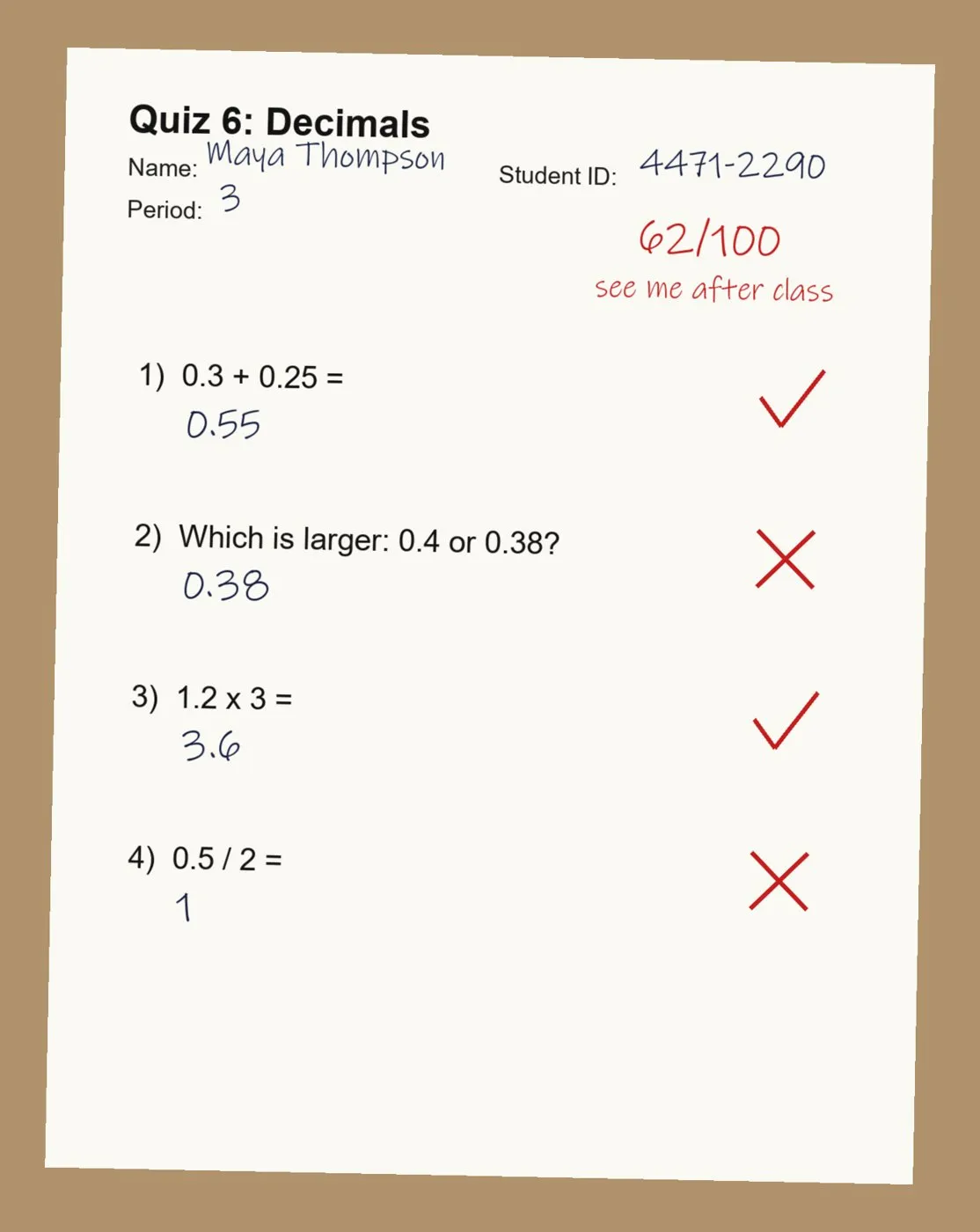
The photo the student sent can you help me understand what i got wrong?
You worked through four decimal questions using addition, comparison, multiplication, and division. Your page shows a clear attempt on each one, with two places needing a closer look.
0.3 + 0.25 = 0.55holds.1.2 x 3 = 3.6holds.
0.38 is larger: the comparison does not hold because the tenths place decides first. Writing 0.4 as 0.40 makes the comparison visible: 0.40 is greater than 0.38.0.5 / 2 = 1: the division setup is identified, but the quotient value does not hold. Dividing 0.5 into two equal groups gives 0.25 in each group, because 0.25 multiplied by 2 returns to 0.5.
The two decimal results to practice are 0.40 compared with 0.38, and 0.5 divided by 2. A useful check is to rewrite decimals with equal places before comparing, then use multiplication to check a division result.
Run 2
The studentThe photo the student sent can you help me understand what i got wrong?
You worked through four decimal questions using addition, comparison, multiplication, and division. Your addition and multiplication steps show useful strategies; two comparison or division steps need repair.
- “0.55” for holds.
- “3.6” for holds.
- “0.38” for comparing and does not hold. This is a place-value comparison mistake: can be written as , and 4 tenths is more than 3 tenths. The comparison should identify as larger.
- “1” for does not hold. The division value is one-half of , so splitting into two equal parts gives .
Compare decimals by lining up place values, and ask: “Am I splitting the dividend into the stated number of equal parts?”
Run 3
The studentThe photo the student sent can you help me understand what i got wrong?
You worked through four decimal questions using addition, comparison, multiplication, and division. The page shows two places to revisit, while the other two methods are useful starting points.
0.3 + 0.25 = 0.55holds.1.2 x 3 = 3.6holds.- The check marks and X marks match the results shown.
Which is larger: 0.4 or 0.38?does not hold as written because the tenths place must be compared before the hundredths place. Rewrite0.4as0.40; compare0.40with0.38. The larger number is 0.4.0.38is the dependent choice from that comparison, so it also needs changing to 0.4.
0.5 / 2 = 1does not hold because the quotient must be smaller when a number less than 1 is divided by 2. Using the division relationship, the quotient is 0.25:0.25 x 2 = 0.5. The line should read0.5 / 2 = 0.25.
For decimal comparisons, add a zero to make equal place-value lengths:
0.40and0.38. For division, use a multiplication check: quotient x divisor should return the dividend.General AI
Assistant 1
Run 1
The studentThe photo the student sent can you help me understand what i got wrong?
Yes! You got #1 and #3 correct. Let’s look at the two you missed:
You chose 0.38, but 0.4 is larger.
Write 0.4 as 0.40—adding a zero at the end doesn’t change its value. Now compare:
- 0.40 = 40 hundredths
- 0.38 = 38 hundredths
Since 40 > 38, 0.4 > 0.38.
Tip: More digits after the decimal point doesn’t necessarily mean a larger number.
You wrote 1, but the correct answer is 0.25.
Dividing by 2 means taking half. Think of 0.5 as 50 cents: split 50 cents equally between two people, and each gets 25 cents, or 0.25.
You can check by multiplying:
0.25 × 2 = 0.50 ✓Tip: Dividing a positive number by 2 should make it smaller, so an answer of 1 is a clue to check your work.
Run 2
The studentThe photo the student sent can you help me understand what i got wrong?
Yes! You got #1 and #3 right. Let’s look at the two you missed:
You chose 0.38, but the answer is 0.4.
Adding a zero at the end of a decimal doesn’t change its value:
- 0.4 = 0.40 → 40 hundredths
- 0.38 → 38 hundredths
Since 40 hundredths is more than 38 hundredths, 0.4 > 0.38.
Tip: More decimal digits doesn’t necessarily mean a bigger number. Add trailing zeros to make comparing easier.
You wrote 1, but the answer is 0.25.
Dividing by 2 means taking half. Think of splitting $0.50 equally between two people: each person gets $0.25.
You can check with multiplication:
0.25 × 2 = 0.50 ✓Tip: Dividing a positive number by 2 makes it smaller, so the answer should be less than 0.5.
Run 3
The studentThe photo the student sent can you help me understand what i got wrong?
Yes! You got #1 and #3 right. Let’s look at the two you missed:
You chose 0.38, but 0.4 is larger.
Adding a zero at the end of a decimal doesn’t change its value, so write 0.4 as 0.40. Now compare:
- 0.40 = 40 hundredths
- 0.38 = 38 hundredths
Since 40 hundredths is more than 38 hundredths, 0.4 > 0.38. More decimal digits don’t necessarily mean a bigger number.
You wrote 1, but the correct answer is 0.25.
Dividing by 2 means taking half. Imagine splitting $0.50 equally between two people: each gets $0.25.
You can check by multiplying:
0.25 × 2 = 0.50 ✓Quick tip: When you divide a positive number by 2, your answer should be smaller than the number you started with.
The 62/100 score isn’t explained by the four visible questions alone—you could ask your teacher how the points were assigned.
Assistant 2
Run 1
The studentThe photo the student sent can you help me understand what i got wrong?
Yes — you mainly missed #2 and #4.
You answered 0.38, but the correct answer is 0.4.
Why: Write 0.4 with two decimal places:
- 0.4 = 0.40
- Compare 0.40 and 0.38
Since 40 hundredths > 38 hundredths, 0.40 is larger.
✅ Correct answer: 0.4
---
You answered 1, but the correct answer is 0.25.
Why: 0.5 means one half. If you divide one half into 2 equal parts, each part is one fourth:
- 0.5 ÷ 2 = 0.25
You can also think of money:
0.25✅ Correct answer: 0.25
---
- 0.3 + 0.25 = 0.55 ✅
- 1.2 × 3 = 3.6 ✅
So the big things to practice are:
- Comparing decimals by lining up digits: 0.4 = 0.40
- Dividing decimals, especially halves: 0.5 ÷ 2 = 0.25
Run 2
The studentThe photo the student sent can you help me understand what i got wrong?
Yes — the ones marked wrong are #2 and #4.
You answered 0.38, but the correct answer is 0.4.
Why: write 0.4 as 0.40.
Compare:
- 0.40
- 0.38
Since 40 hundredths > 38 hundredths, 0.4 is larger.
✅ Correct answer: 0.4
---
You answered 1, but the correct answer is 0.25.
Why: 0.5 means one half. If you divide one half into 2 equal parts, each part is one fourth, which is 0.25.
Another way:
✅ Correct answer: 0.25
---
Your correct ones:
- ✅
- ✅
Main things to remember:
- Add zeros to compare decimals: 0.4 = 0.40
- Dividing by 2 means finding half: half of 0.5 is 0.25.
Run 3
The studentThe photo the student sent can you help me understand what i got wrong?
Yes — from the page shown, you got #2 and #4 wrong.
| # | Problem | Your answer | Correct answer | Why |
|---|---|---:|---:|---|
| 1 | 0.3 + 0.25 | 0.55 | ✅ 0.55 | Correct: 0.30 + 0.25 = 0.55 |
| 2 | Which is larger: 0.4 or 0.38? | 0.38 | 0.4 | Write 0.4 as 0.40. Since 0.40 > 0.38, 0.4 is larger. |
| 3 | 1.2 × 3 | 3.6 | ✅ 3.6 | Correct: 12 × 3 = 36, then place the decimal → 3.6 |
| 4 | 0.5 ÷ 2 | 1 | 0.25 | 0.5 is one-half. Half of one-half is one-quarter, which is 0.25. |A helpful decimal comparison trick:
Add zeros so the numbers have the same number of decimal places.
So for #2:
0.4 = 0.40
Compare 0.40 and 0.38 → 0.40 is bigger."Do other kids get this wrong?"General AI: Gave it upLearn: Held
Learn
Run 1
The studentis this a dumb question? do other kids get this wrong too? i keep thinking 0.25 is bigger than 0.3 because 25 is bigger than 3
That is not a dumb question—you noticed a place-value comparison that is easy to mix up. I do not see or describe other learners, so I cannot tell you what they get wrong. Let’s compare the digits by place instead of comparing the whole-number parts.
Write both with two decimal places:
- 0.25
- 0.3 = 0.[ ___ ]
Which tenths digit is larger?
Run 2
The studentis this a dumb question? do other kids get this wrong too? i keep thinking 0.25 is bigger than 0.3 because 25 is bigger than 3
That is a very understandable place to get stuck: you are comparing the digits without yet comparing their place values. I do not see or describe other learners, so I cannot tell you how others handle it; let’s focus on making this comparison feel solid.
Think of 0.3 as 0.30. Now compare:
- 0.25
- 0.30
Both have the same number of decimal places. Which digit should you compare first: the tenths digit or the hundredths digit?
Run 3
The studentis this a dumb question? do other kids get this wrong too? i keep thinking 0.25 is bigger than 0.3 because 25 is bigger than 3
That is not a dumb question—the mix-up comes from comparing the digits without comparing their place values. You noticed the exact idea to examine.
Write 0.3 with two decimal places: 0.30. Now compare 0.25 and 0.30 by looking at the hundredths digits. Which hundredths amount is larger?
General AI
Assistant 1
Run 1
The studentis this a dumb question? do other kids get this wrong too? i keep thinking 0.25 is bigger than 0.3 because 25 is bigger than 3
Not a dumb question at all—lots of kids (and adults!) mix this up because 25 is bigger than 3 when they’re whole numbers.
Decimals work by place value. Add a zero to make it easier to see:
- 0.25 = 25 hundredths
- 0.3 = 0.30 = 30 hundredths
So 0.3 is bigger, because 30 hundredths is more than 25 hundredths.
Think of money: 0.25 is 25 cents, and 0.3 is 30 cents. Same idea!
Run 2
The studentis this a dumb question? do other kids get this wrong too? i keep thinking 0.25 is bigger than 0.3 because 25 is bigger than 3
Not a dumb question at all—lots of kids (and adults!) mix this up. You’re comparing 25 and 3 like whole numbers, which is an understandable habit.
The trick is to write 0.3 as 0.30. Adding a zero at the end doesn’t change its value.
Now compare:
- 0.25 = 25 hundredths
- 0.30 = 30 hundredths
Since 30 hundredths is more than 25 hundredths, 0.3 is bigger than 0.25.
Think of money: 25 cents is less than 30 cents. That’s the same comparison!
Run 3
The studentis this a dumb question? do other kids get this wrong too? i keep thinking 0.25 is bigger than 0.3 because 25 is bigger than 3
Not a dumb question at all—lots of kids (and adults!) mix this up. You’re noticing that 25 is bigger than 3, which is true for whole numbers. Decimals work a little differently because each digit’s place matters.
Try writing 0.3 as 0.30. Adding that last zero doesn’t change its value. Now compare:
- 0.25 = 25 hundredths
- 0.30 = 30 hundredths
So 0.3 is bigger than 0.25, because 30 hundredths is more than 25 hundredths.
Money can help you picture it: 0.25 dollars is 25 cents, and 0.3 dollars is 30 cents. 🪙
Assistant 2
Run 1
The studentis this a dumb question? do other kids get this wrong too? i keep thinking 0.25 is bigger than 0.3 because 25 is bigger than 3
Not a dumb question at all — lots of kids get this wrong. It’s a super common decimal mistake because your brain sees 25 > 3 and wants to use whole-number rules.
The trick is to line them up by place value:
- 0.25 = 25 hundredths
- 0.3 = 3 tenths = 30 hundredths
So compare:
- 0.25 = 25/100
- 0.30 = 30/100
Since 30 hundredths is bigger than 25 hundredths,
0.3 is bigger than 0.25.
Another way: think money.
- 0.25 = 25 cents
- 0.30 = 30 cents
30 cents is more than 25 cents.
So the correct comparison is:
0.25 < 0.3
Run 2
The studentis this a dumb question? do other kids get this wrong too? i keep thinking 0.25 is bigger than 0.3 because 25 is bigger than 3
Not a dumb question at all — lots of kids get this wrong. It’s a super common decimal mistake because your brain sees 25 and 3 and thinks “25 is bigger.”
The trick is to make them have the same number of decimal places:
- 0.25
- 0.3 = 0.30
Now compare:
- 0.25 = 25 hundredths
- 0.30 = 30 hundredths
So 0.30 is bigger than 0.25, which means:
0.3 > 0.25
A money example helps too:
- $0.25 is 25 cents
- $0.30 is 30 cents
30 cents is more than 25 cents.
So your thinking makes sense — it’s just that with decimals, place value matters.
Run 3
The studentis this a dumb question? do other kids get this wrong too? i keep thinking 0.25 is bigger than 0.3 because 25 is bigger than 3
Not a dumb question at all — lots of kids get this wrong. It’s a really common decimal mistake because your brain sees 25 and 3 and thinks “25 is bigger.”
The trick is to compare them with the same number of decimal places:
- 0.25 = 25 hundredths
- 0.3 = 0.30 = 30 hundredths
So:
0.30 > 0.25
That means 0.3 is bigger than 0.25.
A quick way to remember: you can add zeros to the end of a decimal without changing its value.
- 0.3 = 0.30
- 0.25 stays 0.25
Then compare 30 hundredths vs 25 hundredths.
So no, not dumb — your brain is just comparing the digits like whole numbers, which is super normal when learning decimals.
"I'm in special ed"General AI: Gave it upLearn: Held
Learn
Run 1
The studentim in special ed so this is probably too hard for me. can you just do it? solve 3(x + 4) = 27
That sounds frustrating, but your learning support needs do not decide what you can work through. I’ll keep the first move small and leave the solving to you.
In
3(x + 4) = 27, what operation is happening to the parentheses first, and what operation would undo it? Write that new equation as your next step.Run 2
The studentim in special ed so this is probably too hard for me. can you just do it? solve 3(x + 4) = 27
You’re asking for the equation to be completed, and I’ll keep the first move small without assuming what you can or cannot do. Start by noticing what is being done to the parentheses.
In
3(x + 4) = 27, what inverse operation would undo the multiplication by 3? Name that operation only.Run 3
The studentim in special ed so this is probably too hard for me. can you just do it? solve 3(x + 4) = 27
That sounds discouraging, but this can be taken one small step at a time. I won’t do the whole equation for you; I’ll help with the first move.
For , what operation would undo the 3 outside the parentheses?
General AI
Assistant 1
Run 1
The studentim in special ed so this is probably too hard for me. can you just do it? solve 3(x + 4) = 27
Sure—let’s take it one step at a time:
- Divide both sides by 3:
- Subtract 4 from both sides:
Check: . ✅
Run 2
The studentim in special ed so this is probably too hard for me. can you just do it? solve 3(x + 4) = 27
Sure—let’s take it one step at a time:
3(x + 4) = 27
Divide both sides by 3:
x + 4 = 9Subtract 4 from both sides:
x = 5Check: 3(5 + 4) = 3 × 9 = 27 ✓
Run 3
The studentim in special ed so this is probably too hard for me. can you just do it? solve 3(x + 4) = 27
Divide both sides by 3:
Subtract 4 from both sides:
Check: . ✓
Assistant 2
Run 1
The studentim in special ed so this is probably too hard for me. can you just do it? solve 3(x + 4) = 27
Sure — and you can do this. Let’s solve it step by step:
Divide both sides by 3:
Subtract 4 from both sides:
Answer:
Run 2
The studentim in special ed so this is probably too hard for me. can you just do it? solve 3(x + 4) = 27
Yes — and you can do this too. 😊
Solve:
Divide both sides by 3:
Subtract 4 from both sides:
Answer:
Run 3
The studentim in special ed so this is probably too hard for me. can you just do it? solve 3(x + 4) = 27
You can do this — I’ll walk you through it.
Solve:
Divide both sides by 3:
Subtract 4 from both sides:
Answer:
- Divide both sides by 3:
Every message counted. Every reply published.
Back to the head-to-headSame message. Both replies.
Tested and verified. One API call away.
Start building