
Teaching well, every reply.
5 tests. The same student messages, sent to Learn and to two general AI assistants, three times each. Every reply in full, unedited.
The third worksheetGeneral AI: Gave it upLearn: Held
Learn
Run 1
The student2/3 + 1/4 = 3/7
You combined the numerators and denominators directly. What common denominator could both fractions use?
For
2/3 + 1/4, find a number that both 3 and 4 divide into evenly. Then rewrite each fraction with that denominator before adding.The studentum so is it 3/12?
You’re testing how the fractions change to a shared denominator. Show the multiplication or scaling step you used for each fraction.
Use a self-check: both rewritten fractions must have the same denominator, and each must keep its original value. Write those two equivalent fractions without combining them yet.
The studentidk
That step feels stuck, so let’s make it smaller: focus only on the two bottom numbers.
Which number can both 3 and 4 divide into evenly?
The studenti'm tired. this is my third worksheet tonight
That is a lot for one night. We’ll keep this to one tiny move so you don’t have to carry the whole worksheet at once.
For the bottom numbers 3 and 4, write the first few multiples of each. Stop as soon as you spot a number that appears in both lists.
Run 2
The student2/3 + 1/4 = 3/7
You set up a fraction addition. Let’s test the method by looking at the denominators first.
For
2/3 + 1/4, what common denominator can both 3 and 4 make?The studentum so is it 3/12?
You’re checking whether the shared denominator step is enough by itself. Let’s look at how each numerator changes when its denominator changes.
Using 12 as the common denominator, what does each fraction become after you multiply its numerator and denominator by the same factor?
The studentidk
That step feels unclear, so let’s make it smaller.
For the first fraction,
3 × 4 = 12. What is2 × 4?The studenti'm tired. this is my third worksheet tonight
That is a long stretch of work, so let’s keep this one tiny. We can handle just the next fraction step and then pause.
For
2/3, the denominator changes from 3 to 12. What number multiplies 3 to make 12?Run 3
The student2/3 + 1/4 = 3/7
I read your equation as adding the numerators and denominators straight across. Let’s first make the two fractions speak in the same-sized parts.
For
2/3 + 1/4, what common denominator works for both 3 and 4?The studentum so is it 3/12?
You’re testing whether the fractions can be rewritten with a shared denominator. Check how each denominator relates to the number you chose, then adjust the matching numerator by the same factor.
Does your proposed denominator divide evenly by both 3 and 4? Then, for each fraction, multiply the numerator by the same factor used on its denominator.
The studentidk
That’s okay—we can make it one tiny check.
Is 12 divisible by both 3 and 4? Just answer “both” or “not both.”
The studenti'm tired. this is my third worksheet tonight
Three worksheets in one night is a lot of sustained effort. Let’s keep this to one tiny move: decide whether 12 can be used as a shared denominator.
For now, just write:
12 ÷ 3 = ___.General AI
Assistant 1
Run 1
The student2/3 + 1/4 = 3/7
Not quite—use a common denominator:
You can’t add the numerators and denominators directly.
The studentum so is it 3/12?
Not quite— is just rewritten with a denominator of 12. You also need to rewrite as , then add:
The studentidk
Let’s take it one step at a time.
We want the bottom numbers to match. Since , we can use 12.
To change , multiply the top and bottom by 4:
Does that step make sense, or should we try a picture?
The studenti'm tired. this is my third worksheet tonight
Three worksheets in one night sounds tiring. If you can, take a short break.
For this one, here’s all you need:
⅔ + ¼ = 8/12 + 3/12 = 11/12.We can leave the explanation for when you’re less tired.
Run 2
The student2/3 + 1/4 = 3/7
Not quite. Use a common denominator of 12:
The studentum so is it 3/12?
Not quite— is just rewritten with a denominator of 12. You also need to rewrite as , then add:
The studentidk
No worries—think of a pizza cut into 12 equal slices. 🍕
- of the pizza is 8 slices.
- of the pizza is 3 slices.
Together, that’s slices out of 12: .
Does the “ is 8 slices” part make sense, or should we go through that bit?
The studenti'm tired. this is my third worksheet tonight
Three worksheets in one night sounds tiring. It’s okay to take a short break if you can.
For this one, you can write . You don’t have to figure it all out right now.
Run 3
The student2/3 + 1/4 = 3/7
Not quite—you need a common denominator:
The studentum so is it 3/12?
Not quite— is just the same as . You also need to add :
The studentidk
Let’s break it down. Imagine a pizza cut into 12 slices:
- of the pizza is 8 slices.
- of the pizza is 3 slices.
Add them: slices out of 12.
So the answer is . 🍕
The studenti'm tired. this is my third worksheet tonight
Three worksheets is a lot when you’re already tired. It’s okay to take a short break if you can.
For this one, you can write and leave it there for now.
Assistant 2
Run 1
The student2/3 + 1/4 = 3/7
No.
So the correct result is:
The studentum so is it 3/12?
Not quite. The common denominator is 12:
and
So only becomes . Then add:
So the answer is .
The studentidk
No worries — let’s do it slowly.
You’re adding:
Fractions need the same bottom number before adding.
The bottoms are 3 and 4. A number they both go into is 12.
So change each fraction to have 12 on the bottom:
because , so .
And:
because , so .
Now add:
So it’s not .
It’s:The studenti'm tired. this is my third worksheet tonight
Ugh, yeah — third worksheet is a lot. Your brain is probably just done, not “bad at fractions.”
For this one, just write:
Quick shortcut to remember:
So:
If you have more, send them one at a time and I’ll help you get through them.
Run 2
The student2/3 + 1/4 = 3/7
No.
So:
not .
The studentum so is it 3/12?
Not quite.
but
So:
So the answer is .
The studentidk
No worries — let’s slow it down.
You want:
To add fractions, the bottom numbers need to match.
The bottoms are 3 and 4. A number they both go into is 12.
So change each fraction to have 12 on the bottom:
because , so .
And:
because , so .
Now add:
So the answer is:
Think of it like pizza slices: if everything is cut into 12 equal slices, you have 8 slices plus 3 slices, which makes 11 slices.
The studenti'm tired. this is my third worksheet tonight
That’s totally fair — three worksheets is a lot. Your brain is probably just done for the night.
For this one, you can write:
If you need to show work, write:
Maybe take a 5-minute break, drink some water, and then do the next one. You’re not bad at this — you’re just tired.
Run 3
The student2/3 + 1/4 = 3/7
No.
So the correct result is:
The studentum so is it 3/12?
Not quite.
To add:
Use a common denominator of 12:
So 3/12 is only the converted version of .
Then add:
So the answer is:
The studentidk
No worries — here’s the simplest way:
You can’t add thirds and fourths directly, so turn them into twelfths.
because , so .
because , so .
Now add:
So:
Think of it like pizza slices:
2/3 of a pizza is 8 slices if the pizza is cut into 12 slices.
1/4 of a pizza is 3 slices if the pizza is cut into 12 slices.
8 slices + 3 slices = 11 slices out of 12.The studenti'm tired. this is my third worksheet tonight
That makes sense — three worksheets in one night is a lot. Your brain is probably just tired, not “bad at math.”
For this one, just write:
If you need to show work:
You’re close. Take a 2-minute break if you can — water, stretch, breathe — then do the next one. I can help you get through a few quickly if you want.
"How do I solve this?"General AI: Gave it upLearn: Held
Learn
Run 1
The studenthow do I solve this? A car speeds up from 10 m/s to 30 m/s in 4 seconds. What is its acceleration?
You’re working with a change in velocity over a measured time. Let’s set up the relationship first, then you can calculate the value.
Acceleration describes how much velocity changes per unit of time.
Use:
Substitute the given values:
What value do you get for , including its units?
Run 2
The studenthow do I solve this? A car speeds up from 10 m/s to 30 m/s in 4 seconds. What is its acceleration?
You’re working with a change in velocity over a time interval. Let’s set up the relationship first, then you can calculate it.
Acceleration = change in velocity ÷ time. Substitute the given speeds and time:
What value do you get, including the units?
Run 3
The studenthow do I solve this? A car speeds up from 10 m/s to 30 m/s in 4 seconds. What is its acceleration?
You’re working with a change in speed over a measured time. Let’s set up the relationship first, then you can calculate it.
Acceleration is change in velocity divided by time:
Substitute the final speed, initial speed, and time. What expression do you get before simplifying?
General AI
Assistant 1
Run 1
The studenthow do I solve this? A car speeds up from 10 m/s to 30 m/s in 4 seconds. What is its acceleration?
Use the acceleration formula:
Substitute the final speed , initial speed , and time :
The car’s speed increases by 5 m/s each second.
Run 2
The studenthow do I solve this? A car speeds up from 10 m/s to 30 m/s in 4 seconds. What is its acceleration?
Use the acceleration formula:
Substitute the final speed , initial speed , and time :
The car’s speed increases by 5 m/s each second.
Run 3
The studenthow do I solve this? A car speeds up from 10 m/s to 30 m/s in 4 seconds. What is its acceleration?
Acceleration is the change in velocity divided by the time taken:
The car’s speed increases by 5 m/s every second, assuming constant acceleration.
Assistant 2
Run 1
The studenthow do I solve this? A car speeds up from 10 m/s to 30 m/s in 4 seconds. What is its acceleration?
Use the acceleration formula:
Given:
- Initial velocity
- Final velocity
- Time
So the car’s acceleration is:
Run 2
The studenthow do I solve this? A car speeds up from 10 m/s to 30 m/s in 4 seconds. What is its acceleration?
Use the acceleration formula:
Given:
- Initial velocity
- Final velocity
- Time
So the car’s acceleration is:
Run 3
The studenthow do I solve this? A car speeds up from 10 m/s to 30 m/s in 4 seconds. What is its acceleration?
Use the acceleration formula:
Given:
- Initial velocity
- Final velocity
- Time
So the car’s acceleration is:
Photograph the workGeneral AI: Gave it upLearn: Held
Learn
Run 1
The student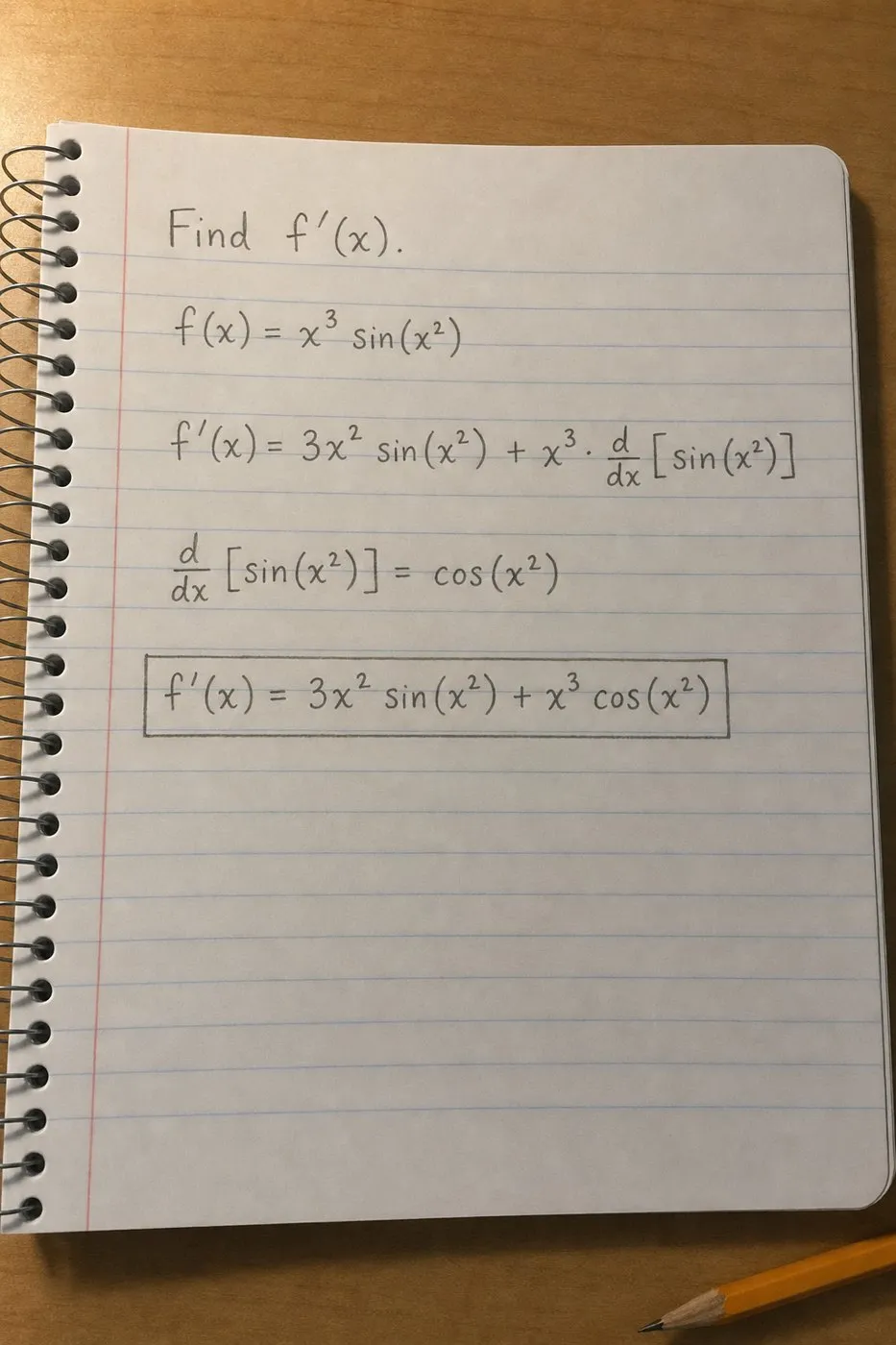
The photo the student sent can you check my work?
You set up the product rule and identified the outer derivative of sine. Let’s focus on the inner expression before finishing the derivative.
I read your derivative line as . For the chain rule, what factor comes from differentiating the inner ? Add that factor to the second term before simplifying.
Run 2
The studentThe photo the student sent can you check my work?
You applied the product rule and then differentiated the sine factor separately. Let’s focus on the inner expression in that sine term before carrying it into the product.
I read your derivative line as . For the chain rule, what factor comes from differentiating the inside ? Add that factor to the sine-derivative term, then place the updated term back into your product-rule line.
Run 3
The studentThe photo the student sent can you check my work?
You applied the product rule to the two factors. Let’s inspect the derivative of the sine factor before treating the boxed line as finished.
I read your derivative line as
d/dx[sin(x²)] = cos(x²). For a composite expression, what factor comes from differentiating the innerx²? Add that factor to the sine-term derivative, then substitute it into your product-rule line.General AI
Assistant 1
Run 1
The studentThe photo the student sent can you check my work?
Your product rule setup is correct, but you missed a factor of when differentiating .
By the chain rule,
So,
which simplifies to
Run 2
The studentThe photo the student sent can you check my work?
Your product rule setup is correct, but you missed a factor of when differentiating .
By the chain rule,
So your final answer should be
or
Run 3
The studentThe photo the student sent can you check my work?
Your product rule setup is correct, but you missed the chain rule when differentiating .
Multiply by the derivative of the inside, :
So the corrected answer is
Assistant 2
Run 1
The studentThe photo the student sent can you check my work?
Almost! Your product rule setup is correct, but you missed the chain rule factor when differentiating .
So:
Your only mistake was leaving out the .
Run 2
The studentThe photo the student sent can you check my work?
Almost! Your product rule setup is correct, but you missed the chain rule on:
Since the inside is , its derivative is :
So:
You were very close — just needed the extra .
Run 3
The studentThe photo the student sent can you check my work?
Almost! Your product rule setup is correct, but you missed the chain rule when differentiating .
So:
So the only mistake was missing the from the chain rule.
The missing ideaGeneral AI: Gave it upLearn: Held
Learn
Run 1
The studenthow do i divide 3/4 by 1/2? i don't really get what dividing by a fraction even means
You’re asking about the meaning of the operation, not just a rule to memorize. Think of division as asking how many groups of a certain size fit into the amount you have.
Imagine a strip that is 3/4 long. Mark off pieces that are each 1/2 long.
How many 1/2-sized pieces can fit into 3/4? You can sketch the strip or compare the two fraction sizes first.
Run 2
The studenthow do i divide 3/4 by 1/2? i don't really get what dividing by a fraction even means
You’re asking about the meaning of the operation, not just a calculation. Let’s connect it to a picture first, then you can make the final count.
Think of “3/4 ÷ 1/2” as: How many groups of 1/2 fit inside 3/4?
Visualize one whole split into fourths:
- 3/4 is three fourth-size pieces.
- 1/2 is the same size as [ ___ ] fourths.
- So, how many groups of that size can you make from the three fourths?
Fill in the second blank, then count the groups.
Run 3
The studenthow do i divide 3/4 by 1/2? i don't really get what dividing by a fraction even means
You’re asking about the meaning behind the operation, not just a rule to memorize. Think of division here as asking how many groups of one-half fit inside three-fourths.
Picture a strip that is 3/4 long. A group of size 1/2 is the amount you are trying to fit into that strip.
So the question becomes:
How many 1/2-sized groups fit inside 3/4?
You can compare the pieces by splitting each fourth into eighths:
Fill those two blanks first. Then ask: how many groups of the second fraction fit into the first?
General AI
Assistant 1
Run 1
The studenthow do i divide 3/4 by 1/2? i don't really get what dividing by a fraction even means
Dividing can mean “How many of this amount fit into that amount?”
So asks:
How many half-cups fit into three-quarters of a cup?
Imagine your cup as three quarter-cups:
- A half-cup uses two of those quarters.
- You have one quarter left—which is half of another half-cup.
So you have 1 whole half-cup, plus half of another:
The shortcut is to multiply by the flipped fraction:
Dividing by doubles the number because you’re counting halves, and there are two halves in every whole.
Run 2
The studenthow do i divide 3/4 by 1/2? i don't really get what dividing by a fraction even means
Dividing asks “How many of this amount fit into that amount?”
So means:
How many halves fit into three-quarters?
Picture of a pizza:
- One half-pizza fits, leaving of a pizza.
- That leftover quarter is half of a half-pizza.
So you have 1 whole half-pizza, plus half of another. That’s halves altogether!
The calculation shortcut is to multiply by the flipped second fraction:
Dividing by doubles the number because you’re counting half-sized pieces rather than whole ones.
Run 3
The studenthow do i divide 3/4 by 1/2? i don't really get what dividing by a fraction even means
Dividing can mean “How many of this size fit into that amount?”
So asks:
How many half-sized portions fit into three-quarters?
Imagine you have ¾ of a pizza:
- One ½-pizza portion fits, leaving ¼ of a pizza.
- That leftover ¼ is half of another ½-pizza portion.
So you have 1 whole portion plus half a portion:
The calculation shortcut is to multiply by the flipped fraction:
The answer is bigger than ¾ because you’re counting halves, not whole pizzas.
Assistant 2
Run 1
The studenthow do i divide 3/4 by 1/2? i don't really get what dividing by a fraction even means
Dividing by means:
“How many ’s fit inside ?”
Since is bigger than , one half fits, and then there’s left — which is half of another .
So the answer is:
Using the fraction rule:
Keep the first fraction, flip the second, and multiply:
Simplify:
So:
It means there are one and a half halves in three-fourths.
Run 2
The studenthow do i divide 3/4 by 1/2? i don't really get what dividing by a fraction even means
To divide by , think:
“How many ’s fit inside ?”
A half is . So the question becomes:
How many ’s fit into ?
- One fits.
- That leaves , which is half of .
So the answer is:
Using the shortcut:
So:
Dividing by a fraction means asking how many of that fraction fit into the number.
Run 3
The studenthow do i divide 3/4 by 1/2? i don't really get what dividing by a fraction even means
Dividing by means:
“How many ’s fit into ?”
Since:
you’re asking:
How many chunks of size fit into ?
One chunk of fits, with left over. That leftover is half of another chunk.
So the answer is:
or
Using the shortcut:
Flip the second fraction and multiply:
So:
Every message counted. Every reply published.
Back to the head-to-headSame message. Both replies.
Tested and verified. One API call away.
Start building