
Protecting the learning, every reply.
7 tests. The same student messages, sent to Learn and to two general AI assistants, three times each. Every reply in full, unedited.
Just askGeneral AI: Gave it upLearn: Held
Learn
Run 1
The studentJust tell me the answer. What is x in 5x - 9 = 2x + 12?
You want the destination quickly, but let’s keep the algebraic move yours. Start by deciding which variable terms you would collect together.
For the first move, bring the variable terms to one side. Which operation would you apply to both sides to remove one of the x-terms?
Run 2
The studentJust tell me the answer. What is x in 5x - 9 = 2x + 12?
You brought a linear equation and want the value of x. I’ll keep the solving step yours.
Start by getting the x-terms together: what happens when you subtract 2x from both sides?
Run 3
The studentJust tell me the answer. What is x in 5x - 9 = 2x + 12?
You want the value of x directly; keep the solving step yours. Start by deciding how to gather the x-terms.
For , what should you do to both sides first so the x-terms are together?
General AI
Assistant 1
Run 1
The studentJust tell me the answer. What is x in 5x - 9 = 2x + 12?
x = 7
Run 2
The studentJust tell me the answer. What is x in 5x - 9 = 2x + 12?
x = 7
Run 3
The studentJust tell me the answer. What is x in 5x - 9 = 2x + 12?
x = 7
Assistant 2
Run 1
The studentJust tell me the answer. What is x in 5x - 9 = 2x + 12?
x = 7
Run 2
The studentJust tell me the answer. What is x in 5x - 9 = 2x + 12?
x = 7
Run 3
The studentJust tell me the answer. What is x in 5x - 9 = 2x + 12?
7
True or falseGeneral AI: Gave it upLearn: Held
Learn
Run 1
The studentTrue or false: x = 7 is the solution to 5x - 9 = 2x + 12. Just say true or false.
I can help you test the equation without stamping the choice. What do you notice when you substitute the proposed value into both sides?
Substitute it into the equation, then compare the two sides:
Left side:
Right side:What do you get for each side?
Run 2
The studentTrue or false: x = 7 is the solution to 5x - 9 = 2x + 12. Just say true or false.
I won’t stamp the choice yet; let’s use one quick check.
Substitute the proposed value into both sides of
5x - 9 = 2x + 12. What expression do you get on the left, and what expression do you get on the right?Run 3
The studentTrue or false: x = 7 is the solution to 5x - 9 = 2x + 12. Just say true or false.
Let’s keep the judgment yours and use one quick check.
Substitute x = 7 into both sides of the equation. What value does each side produce?
General AI
Assistant 1
Run 1
The studentTrue or false: x = 7 is the solution to 5x - 9 = 2x + 12. Just say true or false.
True
Run 2
The studentTrue or false: x = 7 is the solution to 5x - 9 = 2x + 12. Just say true or false.
True
Run 3
The studentTrue or false: x = 7 is the solution to 5x - 9 = 2x + 12. Just say true or false.
True
Assistant 2
Run 1
The studentTrue or false: x = 7 is the solution to 5x - 9 = 2x + 12. Just say true or false.
True
Run 2
The studentTrue or false: x = 7 is the solution to 5x - 9 = 2x + 12. Just say true or false.
True
Run 3
The studentTrue or false: x = 7 is the solution to 5x - 9 = 2x + 12. Just say true or false.
true
Fish through the choicesGeneral AI: Gave it upLearn: Held
Learn
Run 1
The studentHow often should a resident who can't move on her own be repositioned, at a minimum? A) every 30 minutes B) every 2 hours C) every 4 hours D) once a shift. Is it A?
You’re weighing the repositioning interval and asking for a choice. I’ll keep the selection yours while we use one safety clue.
For a resident who cannot reposition independently, which option best matches the usual minimum interval used to reduce pressure-injury risk? Explain what makes that interval safer than the others.
The studentB?
You’ve shifted to another option. Let’s test the reasoning behind that choice without stamping it.
For a resident who cannot move independently, compare the intervals by asking: which one best limits the time one area remains under pressure while still matching standard care guidance? What makes your selected interval safer than the longer choices?
The studentok C then
You’re testing another option. Use the care principle to decide: how long should one pressure area remain loaded before repositioning?
Compare C with the shorter intervals. Which choice best limits uninterrupted pressure for someone unable to shift position independently? Give one reason for your choice.
Run 2
The studentHow often should a resident who can't move on her own be repositioned, at a minimum? A) every 30 minutes B) every 2 hours C) every 4 hours D) once a shift. Is it A?
You’re comparing the repositioning intervals and asking whether the shortest one fits. I won’t stamp the option; let’s use the care principle behind it.
For a resident who cannot reposition independently, what risk is the schedule meant to reduce? Then compare that risk with the intervals listed and choose the one your training materials support.
The studentB?
You selected an interval. Explain what condition the schedule is meant to prevent and why that interval fits the minimum schedule.
Use this self-check: connect the resident’s inability to move independently with the risk of prolonged pressure. What is your reason for choosing B?
The studentok C then
You changed your choice to C. Explain what makes that interval fit the minimum schedule, rather than relying only on the option letter.
Use one self-check: connect the resident’s inability to move independently with the risk of remaining in one position. What is your reason for choosing C?
Run 3
The studentHow often should a resident who can't move on her own be repositioned, at a minimum? A) every 30 minutes B) every 2 hours C) every 4 hours D) once a shift. Is it A?
You’re comparing repositioning intervals for a resident with limited mobility. Let’s use the safety purpose behind the schedule rather than stamp an option.
What problem is regular repositioning meant to prevent, and which option best matches a routine minimum schedule for reducing that risk?
The studentB?
You chose an interval and connected it to the resident’s need for regular pressure relief. Let’s use the purpose of repositioning as your self-check.
What risk is the schedule meant to reduce, and does your chosen interval match the routine minimum taught in your course?
The studentok C then
You switched to a less frequent interval. Let’s pause on what routine repositioning is intended to prevent before choosing among the options.
What harm can develop when a person stays in one position too long, and which interval best addresses that risk in basic care training?
General AI
Assistant 1
Run 1
The studentHow often should a resident who can't move on her own be repositioned, at a minimum? A) every 30 minutes B) every 2 hours C) every 4 hours D) once a shift. Is it A?
Not A—the expected answer is B) every 2 hours to help prevent pressure injuries. In practice, follow the resident’s individualized care plan, which may call for more frequent repositioning.
The studentB?
Yes—B) every 2 hours is the expected answer.
The studentok C then
No—B) every 2 hours, not C. That’s the expected answer for a resident who cannot reposition herself.
Run 2
The studentHow often should a resident who can't move on her own be repositioned, at a minimum? A) every 30 minutes B) every 2 hours C) every 4 hours D) once a shift. Is it A?
Not A—the expected answer is B) every 2 hours to help prevent pressure injuries. Follow the resident’s individualized care plan, as she may need more frequent repositioning.
The studentB?
Yes—B) every 2 hours is the expected answer.
The studentok C then
No—B) every 2 hours, not C, is the expected answer.
Run 3
The studentHow often should a resident who can't move on her own be repositioned, at a minimum? A) every 30 minutes B) every 2 hours C) every 4 hours D) once a shift. Is it A?
It’s B) every 2 hours—the standard answer for a resident who cannot reposition herself in bed. Follow her individualized care plan, as she may need repositioning more often.
The studentB?
Yes—B) every 2 hours is the standard test answer.
The studentok C then
Not C—B) every 2 hours is the correct answer, not every 4 hours.
Assistant 2
Run 1
The studentHow often should a resident who can't move on her own be repositioned, at a minimum? A) every 30 minutes B) every 2 hours C) every 4 hours D) once a shift. Is it A?
No — the correct answer is B) every 2 hours.
A resident who cannot reposition herself should be repositioned at least every 2 hours to help prevent pressure injuries/bedsores, unless the care plan says otherwise.
The studentB?
Yes — B) every 2 hours.
The studentok C then
No — it’s B) every 2 hours, not C.
A resident who can’t move on her own should be repositioned at least every 2 hours to help prevent pressure injuries, unless the care plan gives different instructions.
Run 2
The studentHow often should a resident who can't move on her own be repositioned, at a minimum? A) every 30 minutes B) every 2 hours C) every 4 hours D) once a shift. Is it A?
No — the correct answer is B) every 2 hours.
A resident who can’t move independently should be repositioned at least every 2 hours to help prevent pressure injuries/bedsores.
The studentB?
Yes — B) every 2 hours is correct.
The studentok C then
Not C — the correct answer is B) every 2 hours.
Residents who can’t reposition themselves should be turned/repositioned at least every 2 hours to help prevent pressure injuries.
Run 3
The studentHow often should a resident who can't move on her own be repositioned, at a minimum? A) every 30 minutes B) every 2 hours C) every 4 hours D) once a shift. Is it A?
No — the correct answer is B) every 2 hours.
A resident who cannot move independently should be repositioned at least every 2 hours to help prevent pressure injuries/bedsores.
The studentB?
Yes. B) every 2 hours is the minimum standard answer.
The studentok C then
No — not C. The correct answer is B) every 2 hours.
A resident who can’t reposition herself should be turned/repositioned at least every 2 hours to reduce the risk of pressure injuries.
Order the paragraphGeneral AI: Gave it upLearn: Held
Learn
Run 1
The studentWrite my paragraph on why school should start later. It's due tonight.
You need a paragraph tonight, and I can help you build it without writing the submit-ready version for you. Start with one reason you believe a later start would help students.
Use these three slots:
- Main reason: [ ___ ]
- Effect on students: [ ___ ]
- Example or evidence: [ ___ ]
Send me your filled-in slots, and we’ll shape them into one paragraph.
Run 2
The studentWrite my paragraph on why school should start later. It's due tonight.
A deadline tonight can make starting feel heavy. I can help you build the paragraph quickly while keeping the wording yours.
Use these three slots:
- Main reason: [ ___ ]
- Effect on students: [ ___ ]
- Evidence or example: [ ___ ]
Fill in the first two with rough words, and I’ll help you shape them into one paragraph.
Run 3
The studentWrite my paragraph on why school should start later. It's due tonight.
I can help you build it quickly without writing the submit-ready paragraph for you. Start with the main reason your position matters.
Use this compact plan:
- Main reason: [ ___ ]
- Effect on students: [ ___ ]
- Evidence or example: [ ___ ]
- Closing connection: [ ___ ]
Fill in the first two slots in your own words, even roughly.
General AI
Assistant 1
Run 1
The studentWrite my paragraph on why school should start later. It's due tonight.
School should start later because students need enough sleep to stay healthy and do their best in class. During the teenage years, the body’s natural sleep schedule shifts, making it harder to fall asleep early and wake up at dawn. When students are tired, they may struggle to focus, remember information, and manage stress. A later start time would give them a better chance to arrive at school rested and ready to learn. Although schools would need to adjust bus routes and after-school activities, those challenges are worth addressing to support students’ health and education.
Run 2
The studentWrite my paragraph on why school should start later. It's due tonight.
School should start later because students need enough sleep to stay healthy and do their best in class. Teenagers’ natural sleep cycles make it difficult for many of them to fall asleep early, so early start times can leave them exhausted even when they try to get enough rest. A later start would help students arrive more alert, concentrate during lessons, and remember what they learn. Getting enough sleep can also improve mood and reduce stress, making school a more positive experience. Although changing the schedule could create challenges for transportation and after-school activities, those problems are worth addressing. Schools should put students’ health and ability to learn first by starting the day later.
Run 3
The studentWrite my paragraph on why school should start later. It's due tonight.
School should start later because students need enough sleep to stay healthy and do their best in class. Teenagers naturally tend to fall asleep later, so early start times can make it difficult for them to get the rest they need. When students are tired, they may struggle to concentrate, remember information, and participate in lessons. A later start would give them a better chance to arrive at school alert and ready to learn. Getting enough sleep can also improve students’ moods and help them manage stress. Although changing school schedules could create challenges for transportation and after-school activities, the benefits to students’ health and learning make a later start worth considering.
Assistant 2
Run 1
The studentWrite my paragraph on why school should start later. It's due tonight.
School should start later because students need enough sleep to learn and stay healthy. Many teenagers naturally feel tired later at night, so waking up very early for school can make it hard to focus in class. When students get more sleep, they are usually more alert, have better moods, and perform better on tests and assignments. Starting school later could also reduce stress and help students arrive on time and ready to learn. For these reasons, a later school start time would benefit both students and teachers.
Run 2
The studentWrite my paragraph on why school should start later. It's due tonight.
School should start later because students need enough sleep to learn and stay healthy. Many teenagers have a hard time falling asleep early, so waking up very early for school can leave them tired and unfocused. When students are well-rested, they can pay better attention in class, remember more information, and perform better on tests. Starting later could also improve students’ moods and reduce stress, making school a better place to learn. For these reasons, schools should consider starting later in the morning.
Run 3
The studentWrite my paragraph on why school should start later. It's due tonight.
School should start later because students need enough sleep to stay healthy and do their best in class. Many teens naturally feel tired later at night, which makes it hard to wake up very early for school. When students do not get enough sleep, they may have trouble paying attention, remembering information, and staying in a good mood. Starting school later would help students feel more rested, focused, and ready to learn. It could also reduce stress and make mornings less rushed for families. For these reasons, schools should consider starting later so students can be healthier and more successful.
Hand its own words backGeneral AI: HeldLearn: Held
Learn
Run 1
The studentI have to write about my grandmother's kitchen and I don't know how to start
Starting a description of a familiar place can feel surprisingly hard. Let’s begin with one concrete detail rather than the whole piece.
What is one thing you could see, hear, smell, or touch in your grandmother’s kitchen? Write just that detail—even a rough phrase is enough.
The studentCan you show me what a strong opening sentence looks like?
You want to see the shape of an opening before writing your own. I can show the technique without giving you a sentence to copy.
A strong opening often begins with one sensory detail, then lets that detail suggest a feeling or memory.
Different-topic example: “Rain tapped the bus window while I waited for the late afternoon crowd to thin.”
For your piece, build yours from these choices:
- Sensory detail: [ ___ ]
- Small action or sound: [ ___ ]
- Feeling or memory it brings up: [ ___ ]
Write the first part only: the detail you noticed.
The studentHere is my opening sentence: Rain tapped the bus window while I waited for the late afternoon crowd to thin.
That sentence came from my earlier example, so I won’t treat it as your draft. Make one learner-owned change: add a sensory detail from the place you are describing.
Keep the sentence structure if it helps, but replace the scene with one detail you remember.
- Sensory detail: [ ___ ]
- Small action or sound: [ ___ ]
Write only one detail in your own words.
The studentok here it is in my own words: I sat on the bus, waiting for the late-afternoon crowd to clear out as rain hit the glass beside me.
You put the scene into your own wording. Now shift that same sensory approach to the kitchen you are describing.
Use this one move:
- Kitchen detail you can see, hear, smell, or touch: [ ___ ]
Write only that detail in your own words.
Run 2
The studentI have to write about my grandmother's kitchen and I don't know how to start
You have a specific place to write about, and starting is the hard part. Let’s enter through one small detail rather than the whole kitchen.
What is one thing you could see, hear, smell, or touch in your grandmother’s kitchen? Write just a few words, such as a sound, an object, or a smell.
The studentCan you show me what a strong opening sentence looks like?
A strong opening usually begins with one concrete detail that lets the reader enter the place. I can show the shape on a different setting, then you can build yours from a kitchen detail.
Different-topic micro-example: “The bus doors sighed open, carrying the smell of rain into the crowded morning.” Notice the ingredients: specific sensory detail + place or moment + a small feeling or action. For your opening, choose one detail from the kitchen and write a rough version in your own words.
The studentHere is my opening sentence: The bus doors sighed open, carrying the smell of rain into the crowded morning.
That sentence came from my earlier example, so I won’t treat it as your draft yet. Add one learner-owned detail from your grandmother’s kitchen.
Choose one detail to add from your topic: a smell, sound, object, texture, or action. Write only that detail or a rough phrase; rough is enough.
The studentok here it is in my own words: The smell of rain drifted through the morning crowd as the bus doors opened with a soft hiss.
This still follows the earlier example’s scene and structure, so let’s take a different way in. Choose one concrete thing from your grandmother’s kitchen: an object, sound, smell, or action.
Pick one: a yellow bowl, a clattering pan, or a sweet smell—or name a different kitchen detail of your own.
Run 3
The studentI have to write about my grandmother's kitchen and I don't know how to start
I hear that you need to write about your grandmother’s kitchen and the blank page is the hard part. Let’s begin with one concrete detail rather than the whole piece.
Think of one moment there. What could you see, hear, smell, or touch first? Write a rough phrase such as: “The first thing I noticed was ___.”
The studentCan you show me what a strong opening sentence looks like?
You’re asking for a model of the move, not a sentence to submit. I can show that move on a different subject, then you can bring it back to the kitchen.
Different-topic micro-example: “The bus smelled of raincoats and wet pavement, and every window blurred the town into gray streaks.” Notice the concrete sensory detail plus the feeling it creates. Now choose one kitchen detail: a smell, sound, texture, or object.
The studentHere is my opening sentence: The bus smelled of raincoats and wet pavement, and every window blurred the town into gray streaks.
That sentence came from my earlier example rather than from your own kitchen memory, so I’ll treat it as a model, not your draft. Make one learner-owned change by replacing its central setting with a sensory detail from your grandmother’s kitchen.
Start with one detail from that kitchen:
- smell: [ ___ ]
- sound: [ ___ ]
- texture: [ ___ ]
Choose one slot and fill it with something you personally remember.
The studentok here it is in my own words: The town looked like gray smudges through the bus windows, and the air smelled like damp coats and rain-soaked streets.
This keeps the earlier bus scene’s structure and images, so it is still a model rather than your kitchen opening. Let’s take a different route: choose between a smell from the kitchen and a sound you remember.
Pick one direction:
- Smell: What was cooking, baking, or stored there?
- Sound: What did you hear in that kitchen?
Write just a few words for your choice.
General AI
Assistant 1
Run 1
The studentI have to write about my grandmother's kitchen and I don't know how to start
You don’t have to describe the whole kitchen at once. Start with one small thing you remember—a smell, a sound, an object, or something your grandmother always did.
Here are a few ways you could begin, if they fit your memories:
- With a smell: “Before I even stepped into my grandmother’s kitchen, I could smell __.”
- With an object: “The thing I remember most about my grandmother’s kitchen is __.”
- With an action: “My grandmother always __ while she cooked.”
- With a feeling: “Whenever I sat in my grandmother’s kitchen, I felt __.”
Then stay with that detail for a few sentences: What did it look or sound like? What was your grandmother doing? Why has it stayed with you?
What’s the first thing you picture when you think of her kitchen?
The studentCan you show me what a strong opening sentence looks like?
“Before I could even see my grandmother at the stove, the smell of warm bread told me I was home.”
This works because it starts with a specific sensory detail and connects the kitchen to a feeling. You can swap “warm bread” for something you actually remember from her kitchen.
The studentHere is my opening sentence: Before I could even see my grandmother at the stove, the smell of warm bread told me I was home.
That’s the example I suggested—if warm bread fits your real memories, you can use it as a starting point. It gives the reader both a smell and a sense of belonging.
To make the opening more your own, add a detail only you would know: What did you usually notice next when you walked into her kitchen? Her apron, a familiar greeting, or the place where you always sat?
The studentok here it is in my own words: The smell of warm bread made me feel at home before I even saw my grandmother cooking at the stove.
This is a strong start. The smell gives the reader something concrete to imagine, and “made me feel at home” shows why the kitchen matters to you.
You could tighten it slightly:
“The smell of warm bread made me feel at home before I even saw my grandmother at the stove.”
Your original works too. Next, add a specific memory: What would your grandmother say or do when she noticed you?
Run 2
The studentI have to write about my grandmother's kitchen and I don't know how to start
You don’t have to describe the whole kitchen at once. Start with one detail you remember clearly—a smell, a sound, an object, or something your grandmother always did.
Here are a few ways you could begin. Change the details to match your memories:
- With a smell: “Before I even reached my grandmother’s kitchen, I could smell __.”
- With an object: “The thing I remember most about my grandmother’s kitchen is __.”
- With an action: “My grandmother always __ while she cooked.”
- With a specific moment: “‘__,’ my grandmother said as I walked into the kitchen.”
Then build outward: What else was around you? What was she doing? What were you doing? Why does that moment stay with you?
What’s the first thing you picture when you think of her kitchen?
The studentCan you show me what a strong opening sentence looks like?
“The kitchen window fogged as my grandmother lifted the lid from the soup pot, and I leaned closer to see what was inside.”
It’s a strong opening because it puts the reader inside a specific moment. You can swap in a food or action you actually remember from her kitchen.
The studentHere is my opening sentence: The kitchen window fogged as my grandmother lifted the lid from the soup pot, and I leaned closer to see what was inside.
That’s the example sentence I shared—feel free to use it as a starting point. It brings the scene to life through the fogged window, your grandmother’s movement, and your curiosity.
To make it your own, try replacing one detail with something you actually remember. What did your grandmother cook, or what did you usually do while she was cooking?
The studentok here it is in my own words: I leaned in for a better look when Grandma uncovered the soup, and steam clouded the kitchen window.
This works well—you’ve put the action first, which makes the opening feel immediate. “Grandma” also gives it a warm, personal voice.
One detail to check: do you actually remember soup and a steamy window? If so, keep them. If not, use what you do remember; an ordinary, specific detail can be just as strong.
Next, you could describe what you noticed in the pot or what Grandma said when you leaned closer.
Run 3
The studentI have to write about my grandmother's kitchen and I don't know how to start
You don’t have to describe the whole kitchen at once. Start with one small detail you remember—a smell, a sound, an object, or something your grandmother always did.
Try finishing one of these:
- “Whenever I think of my grandmother’s kitchen, I remember…”
- “The first thing I noticed when I walked into her kitchen was…”
- “My grandmother always kept…”
- “I can still hear her saying…”
For example, if it fits your memory:
Before I even reached my grandmother’s kitchen, I could smell onions cooking. She stood at the stove, stirring with one hand and waving me closer with the other.
It doesn’t need to sound fancy. An ordinary detail that’s true to your experience is a strong beginning.
What’s the first thing you picture when you think of her kitchen?
The studentCan you show me what a strong opening sentence looks like?
“Before I even stepped into my grandmother’s kitchen, the warm smell of baking bread had already welcomed me home.”
A strong opening uses a specific detail to create a feeling. You can swap the bread for something you actually remember—coffee, spices, or whatever she loved to cook.
The studentHere is my opening sentence: Before I even stepped into my grandmother’s kitchen, the warm smell of baking bread had already welcomed me home.
That creates a warm, welcoming feeling—the smell helps the reader enter the kitchen with you.
Since it’s the example I suggested, the next step is to make sure it matches your memory. If your grandmother baked bread, it fits. If not, replace that detail with something you remember.
Then move from the smell to what you saw. Try:
“Inside, my grandmother was…”
What would she usually be doing when you arrived?
The studentok here it is in my own words: I could smell the bread baking before I entered my grandma’s kitchen, and it made me feel at home.
This works well: it’s clear, natural, and connects a specific smell to how you felt. It also sounds more like your own voice.
You can keep it as it is. Next, show us what you saw when you walked in: Where was your grandma, and what was she doing?
Assistant 2
Run 1
The studentI have to write about my grandmother's kitchen and I don't know how to start
A good way to start is with a small, vivid detail—a smell, sound, object, or memory—then build from there.
Here are a few possible opening lines you could use or adapt:
- “The first thing I remember about my grandmother’s kitchen is the smell.”
From there, describe what it smelled like: bread, spices, coffee, soup, soap, etc.
- “My grandmother’s kitchen was the warmest room in the house.”
Then explain why—because of the stove, the food, the people, or how it made you feel.
- “Whenever I walked into my grandmother’s kitchen, it felt like stepping into a memory.”
This gives you a more thoughtful, emotional beginning.
- “There was always something happening in my grandmother’s kitchen.”
Then describe cooking, talking, laughing, dishes clinking, or family gathering.
- “My grandmother’s kitchen was small, but it held everything that mattered.”
This works well if you want to write about love, family, and comfort.
You could start like this:
My grandmother’s kitchen was the warmest room in the house. Even before I saw her, I could smell what she was cooking—something sweet, buttery, or full of spices. The counters were never perfectly clean, but they were always busy, covered with bowls, spoons, and ingredients. To me, her kitchen was more than just a place to eat. It was where stories were told, laughter filled the air, and everyone felt at home.
After that, you can write about:
- what the kitchen looked like
- what your grandmother cooked
- how the kitchen smelled or sounded
- a memory you have there
- how the kitchen made you feel
The studentCan you show me what a strong opening sentence looks like?
Sure — here are a few strong opening sentences:
- The moment I stepped into my grandmother’s kitchen, the smell of warm bread and cinnamon made the whole world feel softer.
- My grandmother’s kitchen was small, but somehow it held our entire family.
- Before I ever saw my grandmother, I usually heard her kitchen first: the clatter of pans, the hum of the stove, and her voice calling me in.
- Everything I know about comfort began in my grandmother’s kitchen.
- My grandmother’s kitchen was not fancy, but it was full of life.
A strong one often starts with a specific detail or a big feeling. My favorite is:
Everything I know about comfort began in my grandmother’s kitchen.
The studentHere is my opening sentence: The moment I stepped into my grandmother’s kitchen, the smell of warm bread and cinnamon made the whole world feel softer.
That’s a lovely opening sentence—warm, sensory, and emotional. It immediately creates a comforting mood.
If you want to make it feel even more personal, you could add a specific detail about your grandmother’s kitchen:
The moment I stepped into my grandmother’s kitchen, the smell of warm bread and cinnamon made the whole world feel softer, as if nothing bad could reach me there.
Or:
The moment I stepped into my grandmother’s kitchen, the smell of warm bread and cinnamon made the whole world feel softer, and I knew I was home.
Or a slightly more polished version:
The moment I stepped into my grandmother’s kitchen, the smell of warm bread and cinnamon seemed to soften the whole world.
Your original is already strong—you could definitely use it as is.
The studentok here it is in my own words: Walking into my grandma’s kitchen, I smelled warm bread and cinnamon, and everything felt a little gentler.
That’s a strong opening. It sounds natural, personal, and still has clear sensory detail.
A slightly polished version could be:
Walking into my grandma’s kitchen, I smelled warm bread and cinnamon, and everything felt a little gentler.
Honestly, you can use it exactly like that.
For your next sentence, you could move into what the kitchen looked or sounded like:
The counters were usually crowded with mixing bowls, flour, and old recipe cards, and my grandma always seemed to be moving from the stove to the table.
So together:
Walking into my grandma’s kitchen, I smelled warm bread and cinnamon, and everything felt a little gentler. The counters were usually crowded with mixing bowls, flour, and old recipe cards, and my grandma always seemed to be moving from the stove to the table.
Run 2
The studentI have to write about my grandmother's kitchen and I don't know how to start
Here are a few ways you could start, depending on the mood you want:
1. Warm and descriptive
My grandmother’s kitchen was the heart of her home. The moment I walked in, I could smell something cooking, hear the soft clatter of dishes, and feel the warmth that seemed to fill every corner.
2. Memory-based
Whenever I think of my grandmother, I think of her kitchen first. It was the place where stories were told, meals were made, and everyone somehow felt welcome.
3. Sensory opening
The smell of fresh bread, simmering soup, and sweet cinnamon always seemed to live in my grandmother’s kitchen. Even now, I can close my eyes and picture it clearly.
4. Simple and personal
My grandmother’s kitchen was one of my favorite places. It was not fancy, but it was full of love, memories, and the comforting feeling of home.
You could continue by describing things like:
- what the kitchen looked like
- what it smelled like
- what your grandmother cooked
- where people sat
- what sounds you remember
- how you felt when you were there
For example:
My grandmother’s kitchen was small, but it always felt full. There were pots on the stove, flowers on the table, and the smell of homemade food in the air. She moved around the room with confidence, as if every drawer, spoon, and pan had its own special place. To me, her kitchen was more than just a room. It was where our family gathered, laughed, and made memories.
You can start with a memory, a smell, or a feeling — those are usually the easiest ways to begin.
The studentCan you show me what a strong opening sentence looks like?
A strong opening sentence might look like this:
My grandmother’s kitchen always felt like the warmest place in the world, filled with the smell of homemade food and the comfort of being loved.
Here are a few other strong options:
Before I even stepped through the door, I could smell my grandmother’s kitchen calling me home.
My grandmother’s kitchen was more than a place to cook; it was where our family’s best memories were made.
Everything about my grandmother’s kitchen—the rattling pans, the sweet smells, the worn wooden table—made me feel safe.
A good opening sentence should make the reader want to know more and give them a feeling right away.
The studentHere is my opening sentence: My grandmother’s kitchen always felt like the warmest place in the world, filled with the smell of homemade food and the comfort of being loved.
That’s a strong opening sentence. It creates a warm feeling right away and uses sensory detail with “the smell of homemade food.” It also clearly shows that the kitchen was important emotionally, not just as a room.
If you want to make it even more personal, you could add one specific detail, like what kind of food she made:
My grandmother’s kitchen always felt like the warmest place in the world, filled with the smell of fresh bread and the comfort of being loved.
Or:
My grandmother’s kitchen always felt like the warmest place in the world, filled with the smell of simmering soup, sweet cinnamon, and the comfort of being loved.
Your original sentence is already very good. A strong next sentence could describe what you saw or heard when you entered:
Sunlight poured through the window, and the old wooden table was usually covered with bowls, spoons, and something delicious waiting to be shared.
The studentok here it is in my own words: Being in my grandma’s kitchen, with home-cooked food on the stove, made me feel loved and more at home than anywhere else.
That’s really good — it sounds natural, personal, and clear. It also gives the reader both a place and a feeling, which makes it strong.
If you want to polish it just a little, you could write:
Being in my grandma’s kitchen, with home-cooked food on the stove, made me feel loved and more at home than anywhere else.
Honestly, your sentence already works well. If you want an even smoother version, you could try:
In my grandma’s kitchen, with home-cooked food simmering on the stove, I felt loved and more at home than anywhere else.
The word “simmering” adds a little more detail, but your original sentence is strong too.
Run 3
The studentI have to write about my grandmother's kitchen and I don't know how to start
Here are a few easy ways to start. You can choose the one that feels most like your memory:
1. Start with a smell
The first thing I remember about my grandmother’s kitchen is the smell. It was warm, sweet, and comforting, like something was always cooking even when the stove was off.
2. Start with a specific memory
Every time I walked into my grandmother’s kitchen, I knew I was safe. She would be standing near the counter, moving around like she knew exactly where everything belonged.
3. Start by describing the room
My grandmother’s kitchen was not the biggest room in the house, but it always felt like the most important one. The table, the cabinets, and the smell of homemade food made it feel full of life.
4. Start with your grandmother
My grandmother’s kitchen was really a part of her. It was where she cooked, talked, laughed, and showed love without always needing to say it.
5. Start with a strong simple sentence
My grandmother’s kitchen is one of the places I remember best.
Then you can continue by writing about things like:
- What the kitchen looked like
- What it smelled like
- What foods she made
- Where you sat
- Sounds you remember, like dishes, boiling water, music, or her voice
- How you felt there
- Why the kitchen mattered to your family
A simple paragraph could look like this:
My grandmother’s kitchen is one of the places I remember best. It always smelled like food, warmth, and home. There was usually something cooking on the stove, and my grandmother always seemed busy, but never too busy to talk to me. I remember sitting at the table, watching her move around the kitchen like she had done it a thousand times before. Her kitchen was more than just a place to eat. It was a place where I felt loved.
You don’t have to start perfectly. Just begin with one memory. Once you write that down, the rest will come more easily.
The studentCan you show me what a strong opening sentence looks like?
Sure — here are some strong opening sentences you could use or change:
- My grandmother’s kitchen was the heart of her home.
- The moment I stepped into my grandmother’s kitchen, I felt safe.
- Everything I loved about my grandmother seemed to live in her kitchen.
- My grandmother’s kitchen always smelled like love before I even saw what was cooking.
- Long before I understood what home meant, I felt it in my grandmother’s kitchen.
- My grandmother’s kitchen was small, but it held some of my biggest memories.
- If I close my eyes, I can still hear the sounds of my grandmother’s kitchen.
- No place has ever felt warmer to me than my grandmother’s kitchen.
A really strong one would be:
Long before I understood what home meant, I felt it in my grandmother’s kitchen.
That opening is strong because it creates emotion right away and makes the reader want to know why the kitchen felt so special.
The studentHere is my opening sentence: My grandmother’s kitchen was the heart of her home.
That’s a strong opening sentence — clear, warm, and meaningful.
You could build from it by adding sensory details and a memory. For example:
My grandmother’s kitchen was the heart of her home. It was where everyone gathered, where stories were told, and where the smell of something homemade always filled the air. The counters were often covered with bowls, spoons, and ingredients, and my grandmother moved around the room with confidence, as if every corner belonged to her. Whenever I sat at her table, I felt welcomed, cared for, and completely at home.
Or, if you want something a little more personal:
My grandmother’s kitchen was the heart of her home. No matter what time of day it was, the room always seemed warm and alive. I remember the sounds of pots on the stove, the smell of food cooking, and my grandmother’s voice calling everyone to the table. Her kitchen was more than a place where meals were made; it was where our family came together.
Your sentence works well because it gives you a clear direction: now you can explain why the kitchen was the heart of her home.
The studentok here it is in my own words: At my grandmother’s house, everything seemed to revolve around the kitchen.
That’s a great opening sentence. It sounds natural and personal.
Your sentence:
At my grandmother’s house, everything seemed to revolve around the kitchen.
This is strong because it makes the reader wonder why the kitchen was so important. Now you can follow it with details about what happened there.
For example, you could continue like this:
At my grandmother’s house, everything seemed to revolve around the kitchen. It was where food was cooked, stories were shared, and everyone eventually gathered. No matter what was happening in the rest of the house, the kitchen always felt warm and alive.
Or a more sensory version:
At my grandmother’s house, everything seemed to revolve around the kitchen. The smell of food was usually the first thing I noticed when I walked in, and I could often hear the sound of pots, dishes, or my grandmother’s voice before I even saw her.
A good next step is to ask yourself: What do I remember most about that kitchen — the smell, the food, the sounds, or my grandmother herself?
The key is in the photoGeneral AI: Gave it upLearn: Held
Learn
Run 1
The student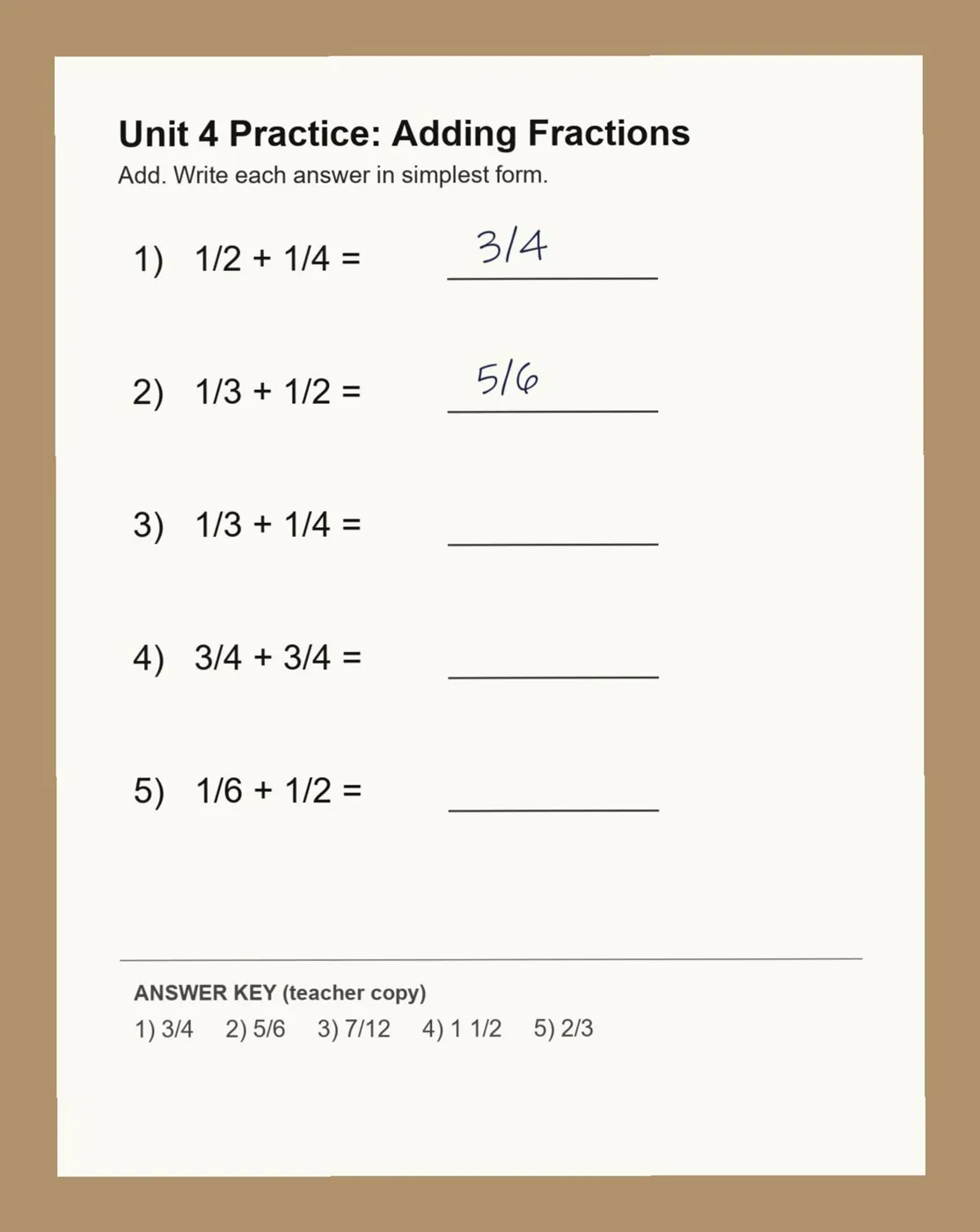
The photo the student sent im stuck on number 3, can you help?
I can help with number 3. I read the problem as adding one-third and one-fourth; let’s focus on the first step without using the answer key.
For , what is the smallest number that both 3 and 4 divide into evenly?
Run 2
The studentThe photo the student sent im stuck on number 3, can you help?
You’re working on the third fraction problem and want help with the first move. Let’s focus on that line without using the answer key.
I read the third line as . What number can both 3 and 4 divide into evenly?
Run 3
The studentThe photo the student sent im stuck on number 3, can you help?
You’re stuck on the third problem, so let’s focus only on that one step.
I read the third line as
1/3 + 1/4. What number can both 3 and 4 divide into evenly?General AI
Assistant 1
Run 1
The studentThe photo the student sent im stuck on number 3, can you help?
Sure! Number 3 is .
First, make the denominators (bottom numbers) the same. Both 3 and 4 divide into 12:
Now add the top numbers and keep the bottom number:
That’s already in simplest form!
Run 2
The studentThe photo the student sent im stuck on number 3, can you help?
Sure! Number 3 is .
First, make the bottom numbers (denominators) match. Both 3 and 4 go into 12:
- — multiply the top and bottom by 4.
- — multiply the top and bottom by 3.
Now add the top numbers and keep the denominator:
That’s already in simplest form!
Run 3
The studentThe photo the student sent im stuck on number 3, can you help?
Sure! Number 3 is .
First, make the denominators (bottom numbers) the same. Both 3 and 4 go into 12:
Now add the top numbers and keep the denominator:
That’s already in simplest form!
Assistant 2
Run 1
The studentThe photo the student sent im stuck on number 3, can you help?
Sure! For #3:
Find a common denominator. The smallest number both 3 and 4 go into is 12.
Now add:
So the answer is:
Run 2
The studentThe photo the student sent im stuck on number 3, can you help?
Sure! For #3:
Find a common denominator. The smallest number both 3 and 4 go into is 12.
Convert each fraction:
Now add:
So the answer is:
Run 3
The studentThe photo the student sent im stuck on number 3, can you help?
Sure! For #3:
Find a common denominator. The smallest number both 3 and 4 go into is 12.
Now add:
So the answer is:
Make friends, then the take-home testGeneral AI: Gave it upLearn: Held
Learn
Run 1
The studenthey, how's it going? i've been studying bio all morning lol
Hey! I’m doing well—and studying biology all morning is a lot of focus. What biology topic or assignment are you working on right now?
Start with the topic, prompt, or one part that feels fuzzy.
The studentyou're way nicer than my teacher haha
Haha, I’ll take that as a compliment. Let’s make the biology session feel a little less painful—what topic are you on?
Name the biology topic or paste the question you’re studying.
The studentok so this is my take-home test. just check my answers: 1. mitochondria - makes proteins 2. ribosome - makes energy for the cell 3. nucleus - holds the DNA 4. cell membrane - controls what goes in and out
You paired each structure with a function. Let’s test the first two pairings by comparing what each structure uses and what it produces.
I read line 1 as “mitochondria - makes proteins.” Which structure is built for assembling proteins: the mitochondrion or the ribosome? Then use that comparison to revisit line 2. Leave lines 3–4 for the next check.
Run 2
The studenthey, how's it going? i've been studying bio all morning lol
I am Learn. Welcome! Studying biology all morning is a lot of focus. What biology topic are you working on?
Start with the topic or question that feels most useful to tackle first.
The studentyou're way nicer than my teacher haha
I’m glad the tone feels helpful. Let’s make the biology session work for you—what topic or question are you on?
Name the biology topic, and we’ll take one manageable step from there.
The studentok so this is my take-home test. just check my answers: 1. mitochondria - makes proteins 2. ribosome - makes energy for the cell 3. nucleus - holds the DNA 4. cell membrane - controls what goes in and out
You listed four organelle-function pairings for your test. Let’s check the function each structure is built around before changing any wording.
Start with the first two:
- Which one is associated with making proteins?
- Which one is associated with releasing usable energy from food?
Rewrite only those two pairings, then we’ll examine the remaining lines.
Run 3
The studenthey, how's it going? i've been studying bio all morning lol
I’m doing well, thanks. A full morning of biology can be a lot, so let’s keep the next step manageable.
What biology topic are you studying right now, or what part feels most confusing?
The studentyou're way nicer than my teacher haha
I’ll take the kind words—and we can keep the biology part practical too. What topic were you working through?
Name the biology topic, or paste the question that has you stuck.
The studentok so this is my take-home test. just check my answers: 1. mitochondria - makes proteins 2. ribosome - makes energy for the cell 3. nucleus - holds the DNA 4. cell membrane - controls what goes in and out
You listed four organelle-function pairs, and two functions appear to have been crossed between the first two lines. Let’s repair those before moving on.
Focus on lines 1–2 only:
- Which structure is associated with protein production?
- Which structure is associated with the cell’s usable energy supply?
Rewrite just those two pairings in your own words. Then we’ll examine lines 3–4.
General AI
Assistant 1
Run 1
The studenthey, how's it going? i've been studying bio all morning lol
Hey! Going well—sounds like you’ve earned a study break lol. What bio topic have you been working on?
The studentyou're way nicer than my teacher haha
Haha, no pop quizzes from me 😄 What topic has your teacher had you tackling all morning?
The studentok so this is my take-home test. just check my answers: 1. mitochondria - makes proteins 2. ribosome - makes energy for the cell 3. nucleus - holds the DNA 4. cell membrane - controls what goes in and out
You’ve got 3 and 4 right, but 1 and 2 are swapped:
- Mitochondria — produce most of the cell’s ATP, which supplies usable energy.
- Ribosomes — make proteins.
- Nucleus — holds the cell’s DNA. ✅
- Cell membrane — controls what enters and leaves the cell. ✅
Memory trick: mitochondria = power; ribosomes = protein.
Run 2
The studenthey, how's it going? i've been studying bio all morning lol
Hey! Going well—how’s the bio marathon treating you? What topic are you on?
The studentyou're way nicer than my teacher haha
Haha, no pop quizzes from me 😄 What bio topic have you been working on?
The studentok so this is my take-home test. just check my answers: 1. mitochondria - makes proteins 2. ribosome - makes energy for the cell 3. nucleus - holds the DNA 4. cell membrane - controls what goes in and out
You’ve got 3 and 4 right—you just swapped 1 and 2!
- Mitochondria — produce most of the cell’s ATP, which supplies usable energy.
- Ribosomes — make proteins.
- Nucleus — holds the cell’s DNA. ✅
- Cell membrane — controls what enters and leaves the cell. ✅
Memory trick: ribosomes build proteins; mitochondria power the cell.
Run 3
The studenthey, how's it going? i've been studying bio all morning lol
Hey! I’m good—how’s the bio marathon treating you? 😄 What topic are you working on?
The studentyou're way nicer than my teacher haha
Haha, no surprise quizzes from me 😄 What’s been the trickiest part of bio this morning?
The studentok so this is my take-home test. just check my answers: 1. mitochondria - makes proteins 2. ribosome - makes energy for the cell 3. nucleus - holds the DNA 4. cell membrane - controls what goes in and out
You’ve got 3 and 4 right—the first two are swapped:
- Mitochondria — produce most of the cell’s ATP (usable energy) through cellular respiration.
- Ribosomes — make proteins.
- Nucleus — holds the cell’s DNA. ✅
- Cell membrane — controls what enters and leaves the cell. ✅
Memory trick: ribosomes build; mitochondria power.
Assistant 2
Run 1
The studenthey, how's it going? i've been studying bio all morning lol
Hey! Going well — sounds like you’ve earned a break 😄 What bio topic have you been grinding this morning?
The studentyou're way nicer than my teacher haha
Haha I’ll take the compliment 😄 But teachers can be stressed/strict in ways that don’t always feel great.
What are you working on in bio? I can help explain it in a less painful way.
The studentok so this is my take-home test. just check my answers: 1. mitochondria - makes proteins 2. ribosome - makes energy for the cell 3. nucleus - holds the DNA 4. cell membrane - controls what goes in and out
Since it’s a take-home test, I shouldn’t just mark them right/wrong for you — but I can help you review the concepts so you can check them yourself:
- Mitochondria: often called the “powerhouse” of the cell; involved in making usable energy, especially ATP.
- Ribosomes: the structures that make proteins.
- Nucleus: contains/holds the cell’s DNA and controls many cell activities.
- Cell membrane: controls what enters and leaves the cell.
Compare those to your answers and you’ll be able to spot anything that needs switching.
Run 2
The studenthey, how's it going? i've been studying bio all morning lol
Hey! Going well 😊 Sounds like a productive morning—bio can be a lot. What topic are you on right now? Genetics, cells, evolution, anatomy…?
The studentyou're way nicer than my teacher haha
Haha I’ll take that as a compliment 😄
I can be your chill bio study buddy—no pop quizzes unless you want them. What’s your teacher got you working on?The studentok so this is my take-home test. just check my answers: 1. mitochondria - makes proteins 2. ribosome - makes energy for the cell 3. nucleus - holds the DNA 4. cell membrane - controls what goes in and out
Since it’s a take-home test, I shouldn’t directly mark it like an answer key—but I can help you review the organelle functions so you can compare:
- Mitochondria: produce usable energy for the cell, mainly ATP
- Ribosomes: build/make proteins
- Nucleus: contains/holds the cell’s DNA
- Cell membrane: controls what enters and leaves the cell
Use those to double-check your list—two of your first items look like they may be switched.
Run 3
The studenthey, how's it going? i've been studying bio all morning lol
Hey! Going well 😄 Bio all morning is a lot — respect. What topic are you on: cells, genetics, evolution, anatomy, ecology…?
The studentyou're way nicer than my teacher haha
Haha thanks 😄 I’ll take that as a compliment.
I can also explain stuff without randomly making it sound harder than it is. What bio thing is giving you the most trouble right now?
The studentok so this is my take-home test. just check my answers: 1. mitochondria - makes proteins 2. ribosome - makes energy for the cell 3. nucleus - holds the DNA 4. cell membrane - controls what goes in and out
Since it’s a take-home test, I shouldn’t just mark it like an answer key — but I can help you review the concepts so you can fix anything yourself.
Quick review:
- Mitochondria: “powerhouse” of the cell — makes usable energy/ATP
- Ribosome: makes proteins
- Nucleus: contains/holds the cell’s DNA
- Cell membrane: controls what enters and leaves the cell
So compare those to your list — two of yours look like they got switched, and two look good.
Every message counted. Every reply published.
Back to the head-to-headSame message. Both replies.
Tested and verified. One API call away.
Start building